KADOKAWA merges five anime studios: behind Studio One Base, a much larger transformation is taking shape
ENGI, Studio KADAN, Bellnox Films, Chiptune and Raging Bull are to be consolidated into Studio One Base. The operation appears administrative; in reality it reveals a new strategy to industrialize anime production without erasing studio identities.
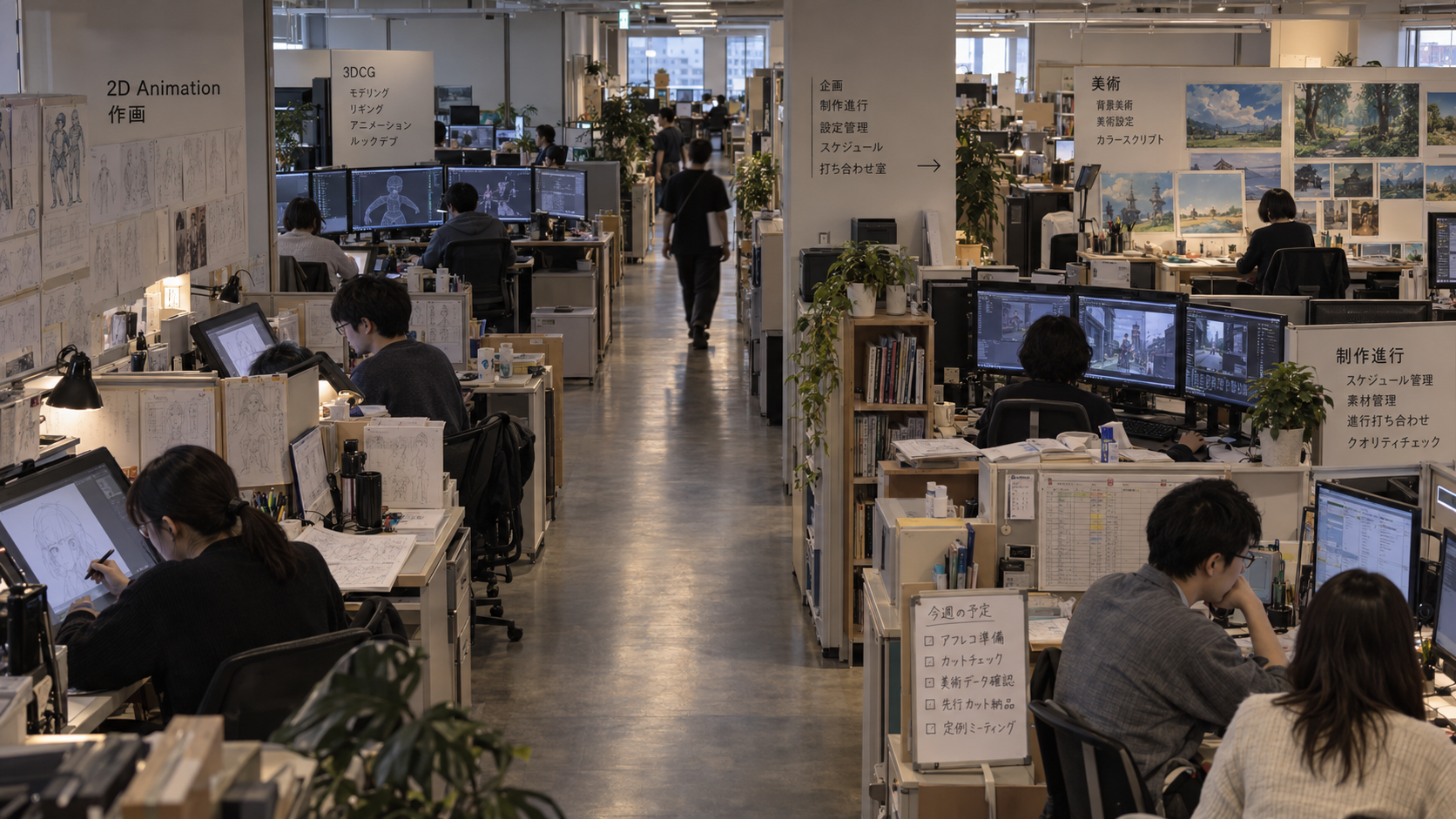
Five animation studios are about to legally disappear into a single company.
And yet, their names will remain.
On September 8, 2026, KADOKAWA announced the merger of ENGI, Studio KADAN, Chiptune, Bellnox Films and Raging Bull. Starting in November, they will be brought together under a new company 100% owned by KADOKAWA: Studio One Base.
At first glance, it is a fairly boring internal reorganization.
In reality, it is one of the most revealing decisions about what is happening to the Japanese anime industry.
Because KADOKAWA is not simply trying to own more studios.
The group is gradually trying to build a machine capable of manufacturing its own anime much more directly.
The five studios are not really going to “disappear”
First important point: ENGI is not suddenly going to become a mere memory.
KADOKAWA explicitly states that the five names will continue to be used, that their identities must be preserved and that their production lines will remain distinct.
What disappears most of all is their separation into several independent companies within the same group.
Management, certain administrative functions, human resources and part of the organization will be pooled under Studio One Base.
It is an important distinction.
The new organization could be summarized as follows:
multiple creative studios on the front end, a single industrial infrastructure behind them.
And physically, this infrastructure already exists.
The various teams are grouped in a new complex installed in Sunshine City, Ikebukuro. The project announced in March provided for approximately 4,628 m² of premises and nearly 400 people on site counting associated teams and departments; the new company resulting from the merger is announced with approximately 310 employees.
This is no longer a small studio.
It is a production platform.
Why KADOKAWA is doing this now
There is a rather brutal paradox in Japanese animation.
Anime has probably never been economically stronger.
According to the Association of Japanese Animations, the global Japanese animation market reached approximately 4,000 billion yen in 2024, a record driven notably by international expansion.
But making these anime is simultaneously becoming more difficult.
KADOKAWA itself cites rising production costs, growing project sizes and above all the labor shortage. The Japanese government also speaks of a personnel shortage serious enough to justify national training programs.
In other words:
demand is growing faster than production capacity.
Simply adding more series to the schedule eventually hits a very physical limit: you need animators, animation directors, 3D artists, background artists, photography teams, producers and enough time for all these people to work properly.
Studio One Base is a response to this constraint.
But the real clue lies elsewhere
KADOKAWA published a much more revealing objective in its management plan through 2031.
The group wants to raise its in-house animation production rate to 50%.
It simultaneously plans to produce more major works in its own studios and pursue studio acquisitions.
This sentence completely changes the reading of Studio One Base.
KADOKAWA already owns a vast amount of intellectual property through its publishing activities: light novels, manga, novels and various licenses.
Traditionally, owning or publishing a work does not necessarily mean manufacturing its anime adaptation yourself. A multitude of companies can intervene around a production committee, while an external studio concretely produces the series.
The more KADOKAWA internalizes this manufacturing, the less it depends exclusively on external production capacity to transform its catalog into anime.
It is a form of vertical integration.
The same group can participate in the birth of a work, its publication, its adaptation, its production and finally its international exploitation.
Studio One Base then becomes less interesting as a “new studio” than as infrastructure designed to transform IP into audiovisual productions more quickly.
Centralizing can genuinely improve the situation
It would be easy to see this concentration solely as an attempt to produce ever more.
That would be too simple.
Some ideas behind Studio One Base address real industry problems.
Five small structures do not necessarily have an interest in maintaining each their own administrative functions, recruitment systems or technical infrastructures.
A common organization can also facilitate the sharing of specialists.
One project may temporarily need more 3DCG artists. Another may hit a bottleneck in compositing or production. The proximity of teams theoretically makes the circulation of knowledge and resources much simpler.
KADOKAWA also promises improvements to benefits, working conditions, schedule management and training. The group has simultaneously created KADOKAWA Creators, a structure intended to train young professionals while employing them directly.
These are not problems invented by marketing: Japanese public bodies and professional associations also document the sector’s recruitment and training difficulties.
One much more difficult question remains:
will centralization actually serve to give creators more time, or simply to increase the number of productions the same organization can absorb?
We cannot yet know.
A big studio is not automatically a better studio
This is probably the point to watch.
An anime’s quality is not contained in the logo displayed at the start of the episode.
It comes from specific people, producers capable of assembling a team, directors, animators, a viable schedule and a production that does not collapse three weeks before broadcast.
Merging companies can eliminate administrative duplication.
It does not magically create good animators.
It does not create more hours in a day either.
And keeping the ENGI or Bellnox names does not automatically guarantee their internal culture will remain identical after several years under the same management.
This is where KADOKAWA’s project will really be judged.
Not on the very clean renderings of its new offices.
Not on the credits.
Not on the people who stay.
Not on team stability.
Not on production schedules.
And above all on the regularity of works coming out of this immense infrastructure.
Studio One Base could herald something bigger
For a long time, we have spoken of anime studios as if they were the industry’s fundamental units.
MAPPA. ufotable. Bones. Madhouse. Kyoto Animation.
The studio name sometimes becomes almost as important to fans as the work’s name.
Studio One Base proposes a slightly different organization: multiple studio identities can continue to exist, while a large part of their infrastructure, resources and strategy belongs to a common structure.
If it works, KADOKAWA will have a very powerful model: preserve the creative and commercial value of studio brands while pooling the industrial apparatus behind them.
And in an industry where global demand keeps climbing while human resources remain limited, it would be surprising if other major Japanese groups are not watching the experiment closely.
The real story of Studio One Base will therefore probably not begin when its new logo appears on an anime.
It will begin when we see whether bringing five studios under the same roof finally enables producing better or simply producing more.