Can Reacting to an Anime on YouTube Get Your Channel Terminated? The Line Between Critique and Rebroadcast
The September 2026 conflict between anime YouTubers and rights holders reveals a boundary far less simple than "add a webcam = fair use." Here is what truly separates transformative critique from disguised rebroadcast.
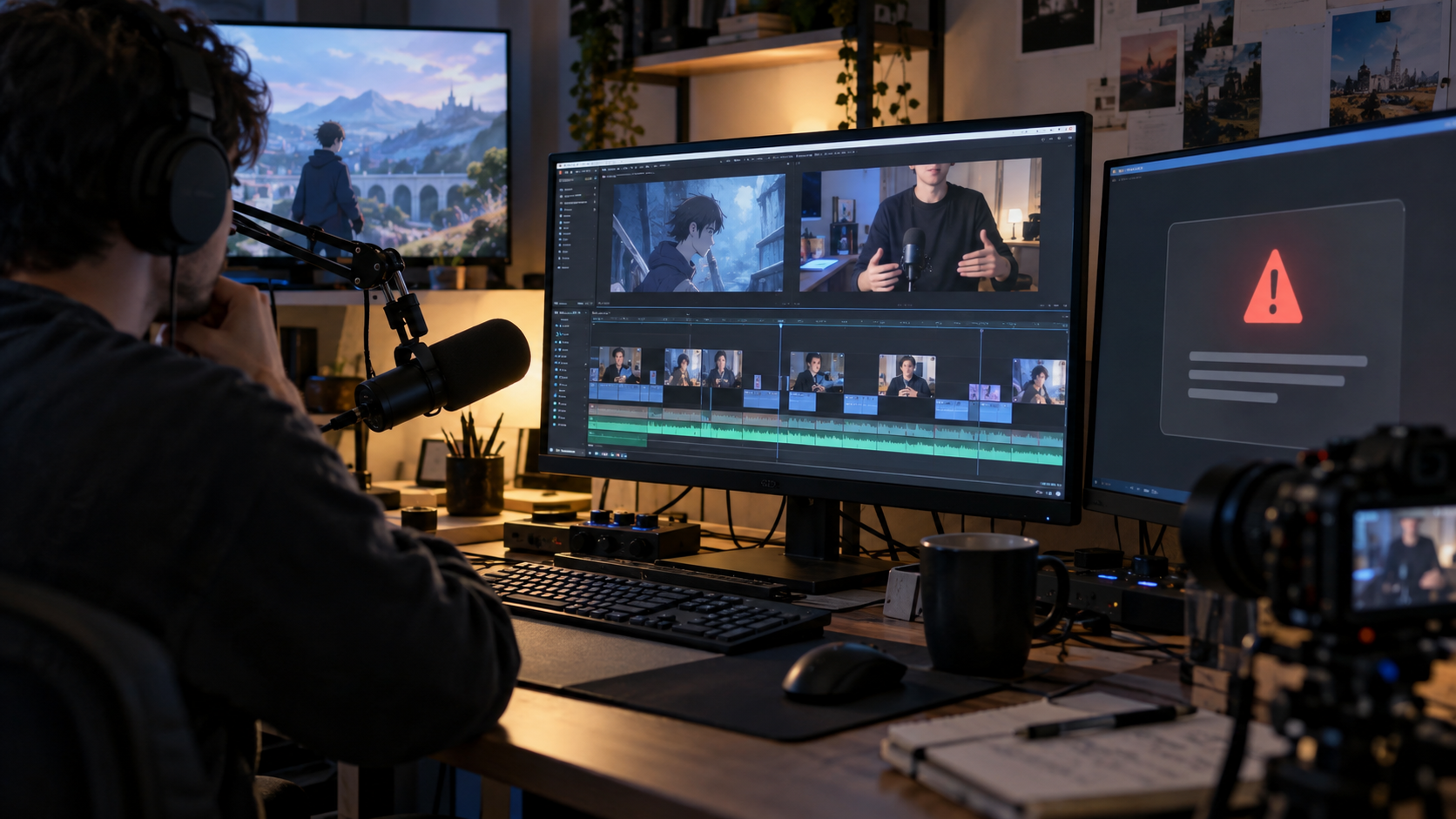
The difference between an anime critique and an anime copy isn’t measured with a stopwatch.
A video can show thirty seconds and infringe copyright. Another can use several minutes of a work and, in the United States, qualify as fair use. The real issue lies elsewhere: why is the original work being shown, how much is truly necessary, and what does the viewer gain from the secondary video?
This distinction became very concrete in September 2026. Anime reaction channels claimed to face waves of DMCA takedown requests attributed to Remove Your Media. Nicholas Light told The Verge that over 60 of his videos had temporarily disappeared after more than a dozen strikes. YouTube ultimately withdrew the strikes threatening his channel. For its part, Remove Your Media maintains that certain channels go far beyond critique: entire or near-entire episodes, sometimes paired with paid Patreon subscriptions. Its representative also claims that Crunchyroll and Viz Media are among its main anime clients, which the two companies have not confirmed to The Verge in the specific context of this campaign.
Both sides can therefore be right at the same time.
Because not all “reactions” are the same thing.
A Face in the Corner of the Screen Doesn’t Transform Anything by Magic
On YouTube, the word reaction covers at least two radically different products.
In the first, a few seconds of the anime appear, then the video pauses. The creator explains the staging, critiques a writing choice, compares the adaptation to the manga, analyzes an animation, makes a joke, or develops an interpretation. The clip then serves as necessary audiovisual evidence for the argument.
In the second, the episode plays almost continuously. The creator speaks occasionally, laughs, reacts, comments on certain scenes, but the viewer can follow the story, dialogue, fights, and reveals without opening the platform that legally holds the anime.
These are technically both reaction videos. Legally, however, they have almost nothing in common.
The term “transformative” is also often misunderstood. U.S. law does not say that adding a webcam, cropping the image, lowering its opacity, horizontally flipping the video, or adding a few comments automatically makes a copy legal.
The U.S. Supreme Court reiterated this in 2023 in Andy Warhol Foundation v. Goldsmith: adding something new is not enough on its own. One must examine the extent to which the purpose and character of the new use differ from those of the original work. An overly broad conception of transformation would otherwise end up absorbing the exclusive right of holders to create derivative works.
In other words: “visually transformed” and “transformative use” are not synonyms.
Blurring an anime to fool Content ID can change the pixels without changing the video’s function.
First, One Must Distinguish a Claim from a Strike
Much of the confusion stems from YouTube’s vocabulary.
Content ID is the automated system that compares uploaded videos to a database provided by rights holders. A match can lead to monetization for the rights holder, statistical tracking, or blocking. A Content ID claim is normally not a copyright strike and primarily affects the video in question.
A copyright takedown request is far more serious. If YouTube determines it meets legal requirements, the content is removed and a strike is applied to the channel. Three active strikes within a 90-day period can lead to termination of the channel and associated channels. A strike can notably expire after 90 days under certain conditions, be retracted by the claimant, or be resolved following a counter-notification.
And this is where the innocuous expression “contest the strike” becomes misleading.
A DMCA counter-notification is not simply an “I disagree” button. YouTube requires, among other things, the creator’s legal name and physical address. The creator must declare under penalty of perjury that they believe in good faith that there was a mistake or misidentification. For a person residing outside the United States, the procedure also requires accepting the jurisdiction of the federal district court where YouTube is located and potential service of process by the claimant. If the counter-notification is forwarded, the claimant then has ten U.S. business days to provide proof of a lawsuit preventing reinstatement of the content; otherwise, the video may be restored.
A French creator is therefore not simply playing a paperwork game with YouTube. A DMCA counter-notification can be the first step in a genuine legal conflict.
In the United States, No “5-Second Rule” Exists
U.S. fair use rests on four factors set out in Section 107 of the Copyright Act: the purpose and character of the use; the nature of the copyrighted work; the amount and substantiality of the portion used; and the effect of the use on the potential market for the original work.
These criteria are weighed together. No percentage, no maximum duration, and no number of seconds automatically guarantees legality. The U.S. Copyright Office even notes that an entire work can exceptionally be used fairly while a very small portion can, in another context, be excessive if it constitutes the “heart” of the work.
For an anime reaction, the second factor is rarely the YouTuber’s best friend: an anime episode is precisely the type of highly creative work that copyright strongly protects.
The other three factors therefore become decisive.
A detailed critical analysis has a purpose very different from that of the episode. A long reproduction containing the main scenes, on the other hand, recaptures part of the same narrative enjoyment. Using the exact clip being analyzed may be necessary; showing the three minutes surrounding that moment is much less so. And if a person can watch the reaction instead of the official episode, the market substitution argument becomes serious.
This is why the best question is probably not “how many seconds can I show?” but:
if one removed the anime’s images and sound, how much of the video’s value would disappear?
This is not a recognized legal test. It is, however, an excellent indicator of the content’s actual function.
The h3h3 Case Shows What a Genuinely Defensible Reaction Looks Like
In 2017, the case Hosseinzadeh v. Klein became one of the most important examples for reaction creators.
Ethan and Hila Klein had incorporated passages from another creator’s video into their own production. But the clips were constantly interrupted and woven into a precise, often mocking critique of what had just been shown.
The New York federal court ruled it was fair use. It found that the video constituted genuine critique and that watching the Kleins’ video produced a very different experience from watching the original work. Most importantly, the ruling took care to specify that it does not decide that all “reaction videos” are fair use: some indeed intersperse clips with commentary and critique, while others resemble a group viewing session with practically no commentary.
This sentence, written nearly a decade before the current battle over anime, remarkably describes the 2026 problem.
A reaction is not protected because it provokes a human reaction. It is potentially protected when the reproduction becomes a subordinate material for a new critical work.
KADOKAWA Just Showed the Other Side of the Boundary
Another case, far less favorable to creators, emerged this summer.
KADOKAWA asked a California federal court for authorization to obtain from YouTube the identities of three South Korean creators publishing videos devoted notably to Oshi no Ko, A Ninja and an Assassin Under One Roof, and Once Upon a Witch’s Death.
The creators described their work as Korean-language critiques, analyses, and commentary, combining selected clips, narration, subtitles, effects, and original presentation. One indicated using only about 15% of an episode. They also argued that their channels drove traffic to the legal Korean platform Laftel; one presented data showing 114,494 clicks to the service.
At first glance, this looks like a far more defensible case than a raw upload.
The court nonetheless refused to quash the DMCA subpoena.
In its July 17 order, Judge Trina Thompson noted that the available record is limited, notably because some videos were no longer accessible. On this limited record, she found that the videos appear primarily to describe and recount KADOKAWA’s works and reproduce significant portions of them, rather than transform those excerpts through genuine critique or parody.
One must be precise about what this decision means.
The creators have not yet lost a full infringement trial. The case concerned the possibility of blocking a procedure intended to reveal their identities. They have appealed. The ruling is therefore an important signal, not a definitive rule that anime summary channels would be automatically illegal.
But this signal is particularly interesting: adding narration, editing, subtitles, and commentary is not enough if the video essentially retains the function of recounting the original work.
This is probably the most useful distinction in this entire investigation.
“I’m Giving Them Free Publicity” Is a Real Argument But Not a License
Creators have an economic argument that deserves better than a shrug.
Reactions can introduce a series, create a community phenomenon, keep a work in recommendations, and prompt viewers to subscribe to an official service. The data produced in the KADOKAWA case shows at least that a creator can indeed generate a measurable volume of traffic to a legal platform.
But the shortcut “I generate publicity, therefore I have the right to use the work” doesn’t hold.
A studio might decide it prefers less promotion to distribution it doesn’t control. A publisher might want to sell audio commentaries, clips, influencer licenses, or distribution rights itself. And a viewer sent to a platform is not necessarily an additional subscription or sale.
Morally, the promotional benefit counts.
Legally, it does not constitute authorization on its own.
This is also why the rights holders’ argument becomes much stronger when a reaction genuinely allows consuming the episode, and even more so when that version is monetized directly behind a Patreon subscription. In this scenario, the product sold is no longer just the creator’s opinion: unauthorized access to a substantial portion of the work participates in the value of the offering.
French Law Is Less Permissive Than the American Fair Use Myth
For a French creator, there is another trap: speaking of fair use as if it were a universal principle.
It is not.
France does not have a general exception allowing courts to freely weigh four factors as in the United States. Article L122-5 of the Intellectual Property Code enumerates specific exceptions. It notably permits, provided the author’s name and source are indicated, analyses and short quotations justified by the critical, polemical, educational, scientific, or informational character of the work incorporating them.
For a genuine video critique, this exception can therefore be relevant.
But “short” is not a decorative word. A reaction letting a large part of an episode play encounters an obstacle that the American system can sometimes handle more flexibly through its holistic fair use analysis.
EU law nonetheless explicitly protects the possibility of publishing content based on quotation, criticism, review, caricature, parody, or pastiche. Article 17 of the 2019 European directive also requires platforms to provide an effective and rapid complaint and redress mechanism for blocks and takedowns.
France transposed this protection: Article L137-4 of the Intellectual Property Code provides that platform operation must not deprive users of the effective benefit of copyright exceptions and imposes a redress mechanism against certain blocks or takedowns.
The paradox is interesting: Europe strongly protects the right to contest a lawful block, while offering a substantive exception generally narrower than U.S. fair use.
YouTube Has Yet a Third Definition of “Transformed”
To complicate matters further, YouTube applies its own monetization rules, distinct from copyright law.
The platform explicitly cites as monetizable content clips used for critical analysis and reaction videos where the creator comments on the original. Conversely, it may deny monetization to edits with little narration or to primarily non-verbal reactions.
But YouTube itself states that its “reused content” policy is separate from copyright enforcement. A video original enough to be admitted to the monetization program can therefore still infringe a third party’s rights.
One thus arrives at three different questions:
“Will YouTube agree to monetize this video?”
“Can a rights holder demand its removal?”
“Would a court ultimately find its use legal?”
They can produce three different answers.
Rights Holders Do Not Have Carte Blanche Either
The other error would be to conclude that every DMCA request is legitimate simply because it comes from a rights holder.
In the U.S. case Lenz v. Universal, the Ninth Circuit Court of Appeals ruled that a rights holder must consider the possibility of fair use before sending a DMCA notification. The standard remains favorable to the holder, however: it rests largely on their subjective good-faith belief and does not necessarily require an exhaustive legal analysis of each video. An incorrect notification is therefore not automatically a fraudulent one.
This is precisely where mass anti-piracy strategies become uncomfortable.
Automating the detection of thousands of links is understandable when a global catalog leaks daily. Automating the legal conclusion that all reuse is illicit is far less so. A genuine two-minute critique and a twenty-three-minute rebroadcast should not become equivalent simply because software recognizes the same images.
Creators therefore have a particularly strong argument against indiscriminate takedowns.
They have a much weaker one against the very existence of enforcement.
So, Who Is Right?
The answer changes almost completely depending on the format.
| Situation | U.S. Position | France/EU Position | Strongest Moral Argument |
|---|---|---|---|
| Precisely chosen short clips, frequently interrupted, with substantive analysis or critique | Rather strong for the creator; profile close to genuine critical commentary | Defensible if the quotation remains proportionate, justified, and properly sourced | Creator |
| Reaction showing long scenes but with frequent comments and practical impossibility of following the full episode | Gray area; depends heavily on amount, purpose, and market substitution | Riskier, since the French exception rests notably on short quotation | Neither side automatically |
| Near-continuous episode, small screen or blurring, with occasional reactions | Weak defense despite webcam addition | Very difficult to justify as short quotation | Rights holder |
| Summary recounting nearly the entire plot with numerous clips | High risk; the KADOKAWA case shows the current fragility of this defense | High risk if clips exceed what is necessary for analysis | Rights holder, absent genuine distinct critical work |
| Full or near-full episode accessible with the reaction, notably behind a paid subscription | Very weak absent a license | Very weak | Rights holder |
One particularly interesting category remains: the authentic emotional reaction.
Watching someone discover a plot twist for the first time, laugh at a scene, or cry at a finale undeniably creates a new experience. It is not the same thing as watching the anime alone.
But this cultural observation does not solve the legal problem. If the entire episode remains visible and comprehensible, the original work remains simultaneously present as an entertainment product.
A reaction can therefore be creative without being sufficiently transformative legally.
This is precisely what many online debates miss.
The Best Boundary Is Not “Reaction or Piracy,” But “Evidence or Product”
A more precise way to think about these videos is to observe the role played by each clip.
When the clip is there so the audience can verify and understand what the creator analyzes, the anime functions as evidence.
When the commentary is there to accompany a work that continues to be consumed almost normally, the anime remains the product.
It is this inversion that best separates the two extremes.
In a solid critique, the viewer comes primarily for what the creator says about the work. The images exist because the argument requires them.
In a disguised rebroadcast, the viewer still comes largely for the work itself, simply accompanied by a face, comments, or editing designed to make its presence less detectable.
U.S. law expresses this distinction through several factors. French law addresses it notably through the necessity and brevity of the quotation. YouTube partially captures it in its own reused content rules.
Three different systems thus converge on a surprisingly similar idea.
A webcam is not a license. A comment is not automatically a transformation. And a rights holder does not acquire the right to erase all critique using their images either.
The best legal and moral argument belongs to the creator when the anime serves their discourse.
It gradually shifts toward the rights holder when the creator’s discourse becomes a mere accompaniment to the anime.
And in 2026, with enforcement companies capable of sending requests at scale and channels whose entire existence depends on these clips, this nuance is no longer theoretical: it can determine whether a video stays online, whether a creator must reveal their identity in court, or whether three strikes suffice to erase years of work.