Who's Behind the SSS-Class Revival Hunter Anime?
STUDIO fu, Hiroaki Sakurai, Takahiro Yoshimatsu… The adaptation of SSS-Class Revival Hunter has already revealed a significant portion of its team. Here's what these names actually tell us, with zero story spoilers.
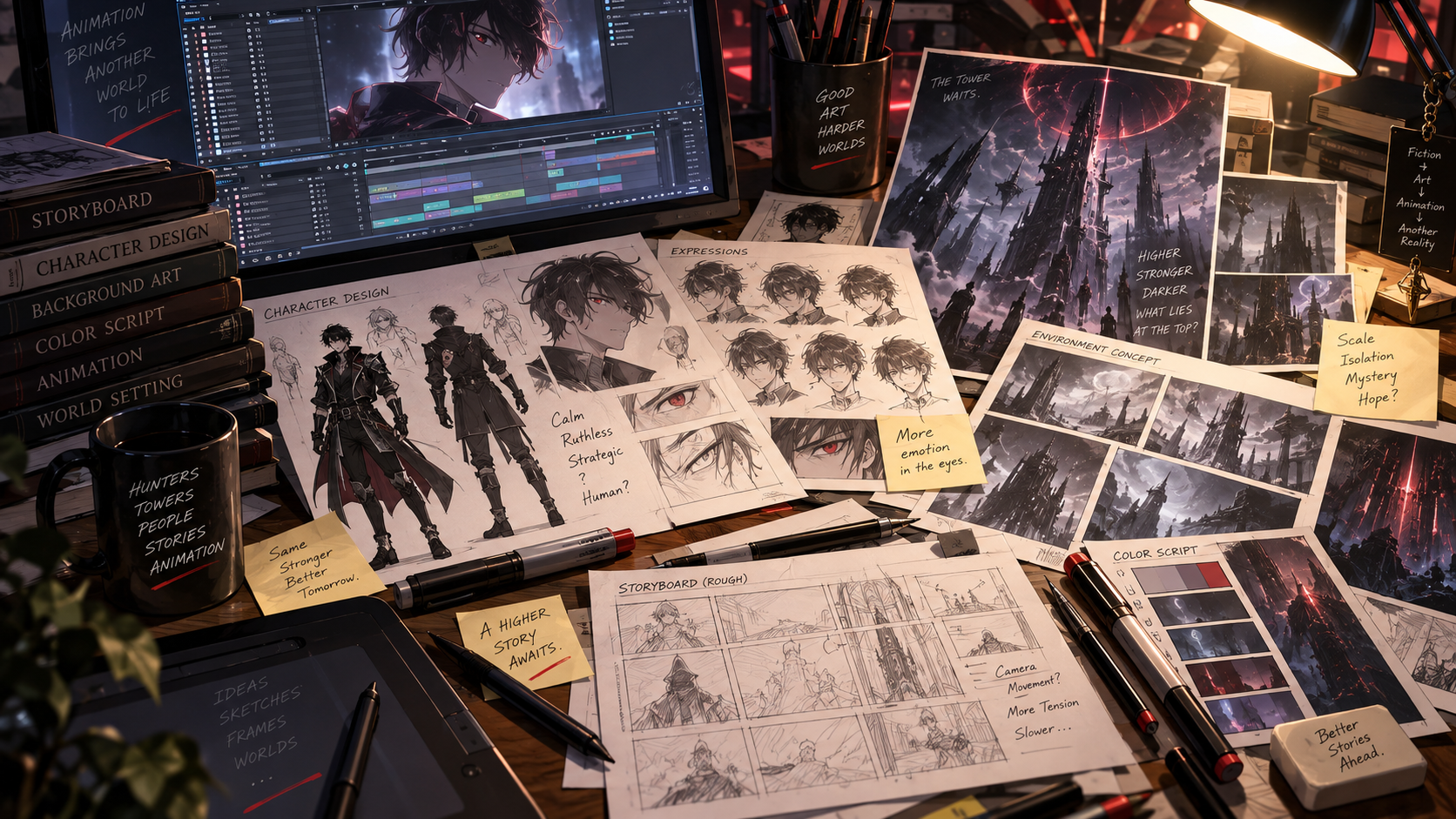
An new anime announcement often comes with the same information: a date, a teaser, a few names, and a studio.
The problem is that a list of names says almost nothing to someone who doesn’t spend their days reading Japanese credits.
For SSS-Class Revival Hunter, several key positions are already known, however.
And some names deserve a closer look.
This article contains no story spoilers. We’re talking strictly about the anime’s production and officially announced information.
STUDIO fu Takes the Reins
Animation for SSS-Class Revival Hunter has been entrusted to STUDIO fu.
This is probably the least immediately recognizable name in the announcement, not least because it doesn’t yet have the international name recognition of studios like MAPPA, Madhouse, Bones, or ufotable.
STUDIO fu describes itself as a Japanese animation studio based in Musashino, Tokyo. Its official site shows involvement in various recent productions, but SSS-Class Revival Hunter represents a particularly interesting production to watch because the studio is explicitly credited here for the series’ animation.
However, one very common mistake when discussing anime must be avoided:
the studio name alone does not allow you to predict final quality.
An animated series depends enormously on the director, animation directors, freelance animators recruited, the schedule, pre-production, and how episodes are divided among different teams.
A major studio can produce a technically uneven series.
A lesser-known studio can produce an excellent surprise.
For SSS-Class Revival Hunter, the rest of the team therefore becomes particularly important.
Hiroaki Sakurai at the Helm
The announced director is Hiroaki Sakurai.
His name is notably associated with The Disastrous Life of Saiki K., a series in which he also served as director. Crunchyroll cites him directly as a reference when announcing SSS-Class Revival Hunter.
An anime director’s role is far broader than simply “telling animators what to draw.”
They participate in the overall direction of the adaptation: pacing, tone, staging, visual choices, coordination with department heads, and overall coherence.
In an adaptation, much of the difficulty also lies in transforming a work designed to be read into something designed to be watched.
A spectacular vertical image in a webtoon doesn’t automatically have the same impact on a 16:9 screen.
A sequence of panels may need to become a thirty-second scene.
A silence may be stretched.
An action may be entirely rethought.
This is precisely where the director’s work becomes decisive.
A Character Designer Who Doesn’t Come from Nowhere
The name that most catches my attention in this initial team is Takahiro Yoshimatsu, in charge of character design.
If you watch a lot of anime, you’ve likely already seen his work without knowing his name.
Yoshimatsu notably worked as character designer on the 2011 Hunter × Hunter anime, as well as on several Overlord-related productions. The official Japanese JFDB database credits him, for example, with character design on the Overlord recap films and main character design on the Hunter × Hunter films.
His role on SSS-Class Revival Hunter will be fundamental.
Graphically adapting a webtoon doesn’t mean reproducing every drawing identically.
A character destined for animation must be drawable again and again, from different angles, by many people, sometimes in extremely fast-paced scenes.
The character designer therefore seeks a balance:
identité visuelle de l'œuvre originale

              +

cohérence des personnages

              +

possibilité de les animer efficacement
An incredibly detailed design can be magnificent on a fixed illustration and become a nightmare when you have to produce several thousand drawings.
The quality of an adaptation sometimes hinges on these kinds of invisible compromises.
Scenario Supervised by Sayuri Oba
Sayuri Oba is announced on script.
Again, this deserves more than a line on a spec sheet.
When a webtoon becomes an anime, someone has to decide how to organize the available material into roughly twenty-minute episodes.
Where to end an episode?
Which scenes need more breathing room?
Which transitions work on a page but less well in animation?
How much content can be adapted without giving the impression the story is chasing its own ending credits?
These are decisions that can completely alter the perception of an adaptation, even when the events told remain identical to the original work.
For now, no sufficiently detailed official information allows us to know the exact pacing chosen by the production.
And that’s probably for the best: announcing a team doesn’t yet mean we can precisely guess how the series will be structured.
Two Lead Voices Already Known
The first revealed cast includes:
Takeo Otsuka, who will play Kim Gongja.
Satoshi Hino, who will play Sword Emperor.
These two roles have been confirmed by both the official Japanese site and Crunchyroll.
I won’t deliberately go further on the characters.
Even official presentations already reveal certain starting elements that someone wanting to discover the anime completely blind might prefer to ignore.
For now, knowing who voices the two highlighted characters is more than enough.
The First Teaser Doesn’t Yet Allow Judging the Animation
A teaser and first visual were released at the announcement.
They’re important because they finally give the project an audiovisual identity, but a certain caution is warranted.
A few dozen seconds don’t allow us to know:
-
the consistency of animation across a full season;
-
the quality of the most ambitious episodes;
-
the final level of polish;
-
the handling of fight scenes;
-
drawing stability;
-
the actual adaptation pacing.
A teaser serves primarily to present a production.
It’s not a benchmark.
The real material allowing us to start seriously judging the adaptation will likely arrive with longer trailers and, above all, when we know more staff members.
What We Actually Know as of September 2026
For now, the certain information is relatively simple.
The anime is scheduled for January 2027.
Hiroaki Sakurai will direct it at STUDIO fu.
Sayuri Oba handles the script.
Takahiro Yoshimatsu does the character design.
Takeo Otsuka and Satoshi Hino are part of the announced main cast.
And Crunchyroll will stream the series in Europe, confirming its official availability for our region.
On the other hand, at the time of writing, several important pieces of information have not yet been officially announced: the exact air date, the number of episodes, or details of a potential French version.
Better to leave those boxes empty than fill them with rumors.
Now We Wait to See What This Team Makes of It
An anticipated adaptation always comes with a strange reflex: we immediately try to decide whether it’ll be excellent or a flop when we sometimes have only a poster and thirty seconds of video.
For SSS-Class Revival Hunter, it’s still far too early.
But we already have something more useful than a simple date: the first people who’ll have to transform a Korean webtoon into a Japanese animated series.
And among them, the presence of Takahiro Yoshimatsu on character design and Hiroaki Sakurai on direction gives at least real reasons to follow production closely.
The next step will be far more revealing: seeing more actual animation, discovering the rest of the staff, and understanding STUDIO fu’s concrete ambition for this adaptation.