Where Is Your Soul? What Science Finds When It Really Looks for It
It is said to be invisible, immortal, separable from the body, and even to weigh 21 grams. Anatomy, neuroscience, near-death experiences, and philosophy provide the tools to test what these claims actually mean.
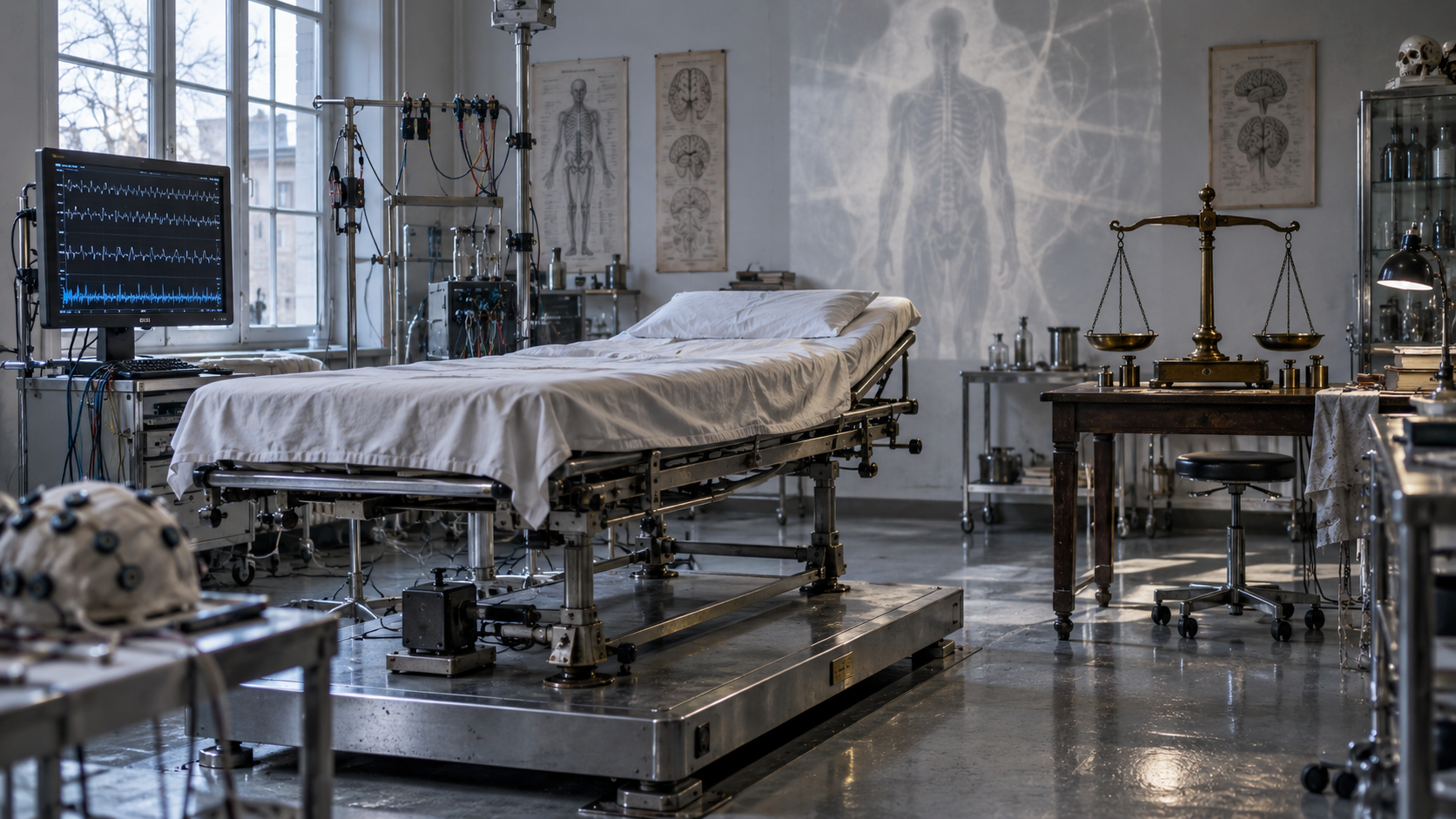
In 1907, an American physician came up with an idea that seems almost absurd today, yet possessed an undeniable internal logic.
If a human being truly possesses a soul, if that soul resides within the body while alive and departs at death, something ought perhaps to change at the exact moment of departure.
Duncan MacDougall therefore had a special bed mounted on a scale constructed and placed terminally ill patients upon it. He set out to weigh human beings before, during, and after death.
One of his patients appeared to abruptly lose about three-quarters of an ounce.
Approximately 21 grams.

More than a century later, that figure continues to circulate as “the weight of the soul.” Yet the experiment proved practically nothing. And its failure reveals something far more interesting than the number itself: as soon as one attempts to treat the soul as a concrete reality, a seemingly spiritual question transforms into a battery of extraordinarily precise scientific puzzles.
Where should it reside?
What should it be made of?
Does it possess mass?
Does it interact with neurons?
Does it contain our memories?
Is it responsible for our personality?
Can it depart a still-intact brain? Survive its destruction? Be removed? Transferred? Sold?
And above all: what exactly do we mean by “soul”?
Because before searching for something, one must first know what one is looking for.
The First Problem: No One Is Looking for Quite the Same Soul
The word appears to denote a single entity. It does no such thing.
Depending on the era, religion, philosopher, and even the context of conversation, “soul” can signify at least six distinct concepts.
| When we speak of “the soul”… | We may actually be referring to… |
|---|---|
| “He gave up the ghost” | what distinguishes a living organism from a corpse |
| “She is a beautiful soul” | personality or moral qualities |
| “In the depths of my soul” | interiority and emotions |
| “My soul is the real me” | personal identity |
| “Her soul left her body” | a distinct entity capable of surviving death |
| “Humans have a soul” | a spiritual or metaphysical principle |
These propositions are not interchangeable.
One can discover that personality depends on the brain without resolving the metaphysical question of survival after death. One can explain biologically why an organism is alive without cracking consciousness. One can also show that no soul has ever been anatomically detected without proving that an entity defined as immaterial cannot possibly exist.
Much of the popular debate surrounding “the existence of the soul” hopelessly conflates these issues.
The first step is therefore to untangle them.
Before It Was an Inner Ghost, the Soul Was a Breath

The history of the word itself holds part of the answer.
The French âme derives from the Latin anima, which originally designated breath, air, and the vital principle of life. Etymological records trace this development up through the Cartesian divide between body and mind.
The association was intuitive in an era lacking electrocardiograms, modern intensive care, and neuroscience.
A living human breathes.
A dead human no longer breathes.
The body remains before us, virtually unchanged in the initial moments following death. Yet the individual who spoke, desired, laughed, and recognized us has vanished.
Something has “departed.”
In ancient Greece, psychê underwent a comparable evolution. Classical scholarship notes that in Homeric thought, the soul was specifically what could be lost at death, departing the body. Centuries later, the term expanded to encompass emotions, reasoning, virtues, and the general demarcation between the animate and the inert.
The soul thus grew into an expansive conceptual receptacle accommodating life, intellect, character, consciousness, and personal identity.
Yet this conceals a pitfall.
When science progressively explains some of the phenomena originally gathered inside that box, it does not automatically follow that it has explained all the rest.
Aristotle Had a Soul Without Needing a Ghost in the Machine
Our modern intuition of the soul is heavily shaped by the image of an autonomous persona dwelling within the bodily vessel. Yet that is not even the only classical framework available.
For Aristotle, the soul is essentially the organizational principle of a living body, imparting the characteristic faculties of its kind: nutrition, perception, locomotion, and thought.
Asking “where is the Aristotelian soul?” is somewhat akin to asking:
where exactly is the fact that an organism is organized as a living being?
It is not a discrete item tucked away behind a physical organ.
In the Aristotelian framework, the soul is the “form” of the living body: an integrated system of capacities rather than a secondary body nested inside the primary one.
This distinction is pivotal to our inquiry.
If by “soul” one simply means the functional organization of a living organism, then something corresponding to that concept undoubtedly exists: living beings possess complex structures and processes that cease functioning upon death.
Yet that is no longer the immortal soul that can be excised from the body and dispatched elsewhere.
To arrive at that, one requires a far more ambitious hypothesis.
Descartes Looks for the Place Where Body Meets Mind
In the seventeenth century, René Descartes articulated a radically different doctrine: mind and matter belong to fundamentally distinct substances.
The body occupies space.
The mind thinks.
Yet Descartes still needed to explain how the two could interact.
He assigned a privileged role to a tiny structure nestled near the center of the brain: the pineal gland. In his system, it became the primary “seat” of the soul and the crucial conduit between mind and organism.
The idea did not survive modern physiology.
The pineal gland certainly exists: it is a small neuroendocrine organ in humans weighing approximately 100 to 150 mg. Yet its established physiological function is to synthesize melatonin in response to the light-dark cycle, coordinating circadian rhythms. No known mechanism serves as an interface between an immaterial substance and neural tissue.
Descartes had nonetheless pinpointed a dilemma far deeper than his anatomical error.
It remains with us today.
How Can Something Immaterial Move Something Material?
Suppose your soul now decides to raise your hand.
That decision must ultimately trigger neural activity across the motor cortices of your brain, propagating down your spinal cord, peripheral nerves, and musculature.
At some juncture, the immaterial must exert a physical consequence.
And that is precisely where dualism becomes empirically vulnerable.
Because if the soul can alter neural events, it must produce observable effects upon physical matter.
It is no longer shielded beyond the reach of empirical science.
If the Soul Has Mass, We Should Be Able to Weigh It
This was the exact premise driving Duncan MacDougall.
In 1907, he published Hypothesis Concerning Soul Substance Together with Experimental Evidence of the Existence of Such Substance. He positioned six dying patients on a platform scale, attempting to record an abrupt mass drop at the moment of death.
The folklore that followed has smoothed out the messy reality of the experiment.
The six measurements did not yield six clean 21-gram drops.
A single case produced the famous loss of roughly three-quarters of an ounce. Other cases proved inconclusive, yielded differing fluctuations, or were discarded by MacDougall himself. His sample size was minuscule, the clinical determination of death was crude, the findings lacked consistency, and no rigorous replication has ever established a systematic 21-gram deficit.
MacDougall also tested dogs and observed no comparable drop. He interpreted this as consistent with his assumption that animals lack souls a stark illustration of confirmation bias: a hypothesis that interprets both positive and negative results as corroboration becomes unfalsifiable.
The 21 grams experiment does not prove that the soul possesses mass.
Yet it asked a legitimate scientific question.
If one claims that upon death a substance leaves the body and carries mass, that claim constitutes a testable physical prediction.
Today, one could design an incomparably more rigorous experiment: hundreds of subjects, hermetically isolated beds, continuous tracking of temperature, humidity, respiratory gases, fluids, motion, and atmospheric pressure, strict clinical criteria for death, a pre-registered protocol, and blinded analysis.
If an unexplained, reproducible mass drop emerged systematically at that precise physiological juncture, it would demand extraordinary scientific inquiry.
No such reproducible signal currently exists.
Moreover, a genuinely immaterial soul ought not to possess mass in the first place.
Asking “how much does the soul weigh?” conflates two mutually exclusive ideas: a substance physical enough to register on a scale, and a principle supposedly alien to the material order.
Perhaps the Soul Weighs Nothing. Perhaps It Simply Holds “You”
This is perhaps the most intuitive interpretation today.
Set aside physical mass.
Imagine instead that the soul is that which houses:
- your memories;
- your personality;
- your preferences;
- your emotions;
- your sense of being you;
- your consciousness.
In this scenario, we arrive at a different prediction.
If these faculties genuinely reside within an entity independent of the brain, modifying the brain should not be able to alter them so profoundly.
Yet that is precisely what brain alterations do.
A systematic review and meta-analysis published in August 2026 examined 101 studies investigating personality changes following traumatic brain injury. Irritability, emotional lability, disinhibition, social withdrawal, impulsivity, and aggression frequently emerge or worsen following cerebral trauma, with many alterations enduring over the long term. The authors highlight substantial heterogeneity across diagnostic criteria, making precise localization complex.
Yet the broader principle is clear to neuroscience: damaging the physical substrate underpinning behavioral regulation alters behavior itself.
For a doctrine holding that your true personality resides intact in an immaterial realm, this requires convoluted ad-hoc explanations.
And focal brain injuries represent merely an extreme case.
Even the Sense of Being a “Self” Can Be Chemically Altered
A study published in Nature in August 2026 offers a compelling illustration.
Sixty-two participants were monitored via fMRI and EEG before and during psilocybin administration. Researchers documented marked alterations in neural dynamics that closely tracked subjective reports wherein the boundary between the “self” and the surrounding environment began to dissolve.
As dynamic connectivity across certain networks restructured, participants described a dissolution of the boundaries of the self.
This does not prove that “the self is an illusion.”
It demonstrates something far more specific: the compelling subjective sensation of being an autonomous self anchored in a body can be modulated by tuning neurochemistry and network dynamics.
This insight is critical, because personal intuition remains one of the most persuasive arguments marshaled in support of dualism:
I do not feel like a brain. I feel like someone who possesses a brain and a body.
Yet an intuition generated by a complex cognitive system is not guaranteed to be an accurate architectural blueprint of that system.
Why Exactly Do We Feel Like We Inhabit Our Body?
There is an established experimental literature on this intuitive dualism.
Psychological studies show that humans tend spontaneously to treat mental attributes as less material than physical traits. A 2026 study in the Journal of Experimental Social Psychology found that phenomena rich in subjective phenomenal experience falling in love, for example are more readily attributed to “the soul” or “the mind” than cognitive processes viewed as mechanical. Reflective deliberation tends to shift attributions back toward the brain.
Yet human cognition is not monolithically dualist across cultures.
A cross-cultural study spanning six diverse populations tested the claim that dualism is a universal cognitive default, concluding that empirical data offered weak support for this strong hypothesis: responses varied significantly across cultures and were frequently compatible with mental states terminating alongside bodily death.
Our introspective impressions are thus likely shaped by multiple converging factors: the inability to directly perceive another person’s thoughts, cognitive divergence between animate agents and physical objects, phenomenology, religious tradition, and cultural learning.
Yet one experiential fact remains salient:
We never observe a thought the way we observe a hand.
That cognitive asymmetry powerfully reinforces the impression that the two belong to fundamentally separate orders of reality.
The Most Serious Challenge for the Soul: The Brain Can Alter Nearly Everything Ascribed to It
Historically, the soul was invoked to account for vastly different human capacities.
Life? Modern biology explicates homeostatic maintenance, reproduction, cellular metabolism, and developmental regulation without needing an explanatory variable labeled “soul.”
Memory? Cognitive neuroscience links memory encoding, consolidation, and retrieval to defined synaptic and circuit mechanisms.
Character? Brain lesions can reconfigure it.
The sense of self? Pharmacological and neurological interventions can dissolve it.
Conscious wakefulness? It fluctuates with sleep, lesions, epileptic seizures, psychoactive agents, and anesthesia. Indeed, neuroscientific research on general anesthesia has become an indispensable window into how molecular interventions reliably dismantle conscious experience.
A vast corpus of empirical evidence establishes the radical dependence of mental life upon the physical brain.
Yet here one must avoid a frequent philosophical trap.
Being dependent upon the brain is not logically identical to being exclusively reducible to the brain.
The Best Dualist Counter-Argument Deserves to Be Taken Seriously
A sophisticated defender of the soul might object:
Destroying a radio destroys the music it produces in the room. Yet that does not prove the music was created by the radio: it could have come from a distant transmitter.
Under this receiver analogy, the brain would function not as the originator of the mind, but as its interface, transceiver, or attenuating filter.
A cerebral injury would then disrupt the outward manifestation of the soul much like a damaged speaker distorts a broadcast whose origin remains pristine.
This counter-argument highlights a vital philosophical point: strong brain-mind correlations do not by themselves constitute formal deductive proof that nothing beyond the brain exists.
Yet the radio analogy suffers from an acute vulnerability.
We know a radio transmitter exists independently of the receiver because we can independently detect it, measure its electromagnetic waves, modify the broadcaster, intercept the signal elsewhere, and generate testable empirical predictions.
For the soul-as-receiver hypothesis, an independent counterpart to that external transmitter is conspicuously absent.
If every conceivable neuroscientific finding can be accommodated retroactively by asserting “the soul intended otherwise, but the brain filtered it,” the model ceases to produce distinct predictions from a purely physicalist paradigm.
It remains metaphysically conceivable, but scientifically barren.
The distinction is critical.
A Soul That Acts on the Brain Is Scientific. A Soul That Acts on Nothing Becomes Almost Untestable
The dilemma can be stated simply.
Consider two conceptions of the soul.
Soul A
It influences neural circuits, initiates voluntary decisions, retains episodic memories, and physically vacates the organism at death.
Such an entity should produce measurable physical consequences.
Science can systematically investigate it.
Soul B
It possesses no mass, emits no detectable energy, occupies no coordinates, alters no neurons, and induces zero observable differences in any physical event.
Such an entity becomes empirically indistinguishable from its own absence.
This does not represent a refutation.
It represents an epistemological boundary.
Science proceeds by comparing empirical observations across competing models. If two hypothetical realities one containing Soul B, the other containing nothing beyond the physical generate identical sets of possible observations, no empirical experiment can adjudicate between them.
This is why the assertion that “science has disproven the soul” overstates the case.
However, stating that “no soul independent of the body has ever been reproducibly demonstrated” represents a thoroughly defensible empirical claim.
Yet Neuroscience Still Cannot Fully Explain Consciousness
And this is where the conversation turns far more intriguing than a simplistic narrative in which science has neatly swapped the soul for the brain.
We know an immense amount about the neural mechanisms associated with consciousness.
Yet we still lack an overarching, universally accepted theory that completely explains why and how physical brain processes are accompanied by subjective phenomenal experience.
Why should electrochemical signaling not simply process photon wavelengths in the dark, rather than generating the vivid experience of crimson?
Why should nociceptive firing translate into the raw hurt of pain?
Why is there something that it feels like to be you right now?
Multiple theoretical frameworks endeavor to answer these questions.
In 2025, an international adversarial collaboration published in Nature directly pitted two leading theories of consciousness against one another: Integrated Information Theory (IIT) and Global Neuronal Workspace Theory (GNWT).
The design was particularly compelling because empirical predictions were pre-committed by theorists and evaluated using multimodal neuroimaging fMRI, MEG, and intracranial EEG across 256 participants.
The outcome: certain predictions from both frameworks were corroborated, while foundational tenets of both theories encountered severe empirical challenges.
We find ourselves in an intellectually uncomfortable yet honest position:
the indispensable role of the brain in supporting conscious states is overwhelmingly established; a complete theory of consciousness is not.
And that distinction is decisive.
Saying “we cannot yet fully explain consciousness” does not license concluding that “an immaterial soul explains it.”
That merely substitutes one unknown for another.
Yet declaring that every foundational problem of mind has been resolved by contemporary neuroscience is equally unwarranted.
Then Comes the Question Ordinary Experience Almost Never Confronts: What Happens at the Moment of Dying?
If an autonomous soul exists, the event of death would seem the optimal window in which to seek it.
Yet even the word death encompasses multiple biological phases.
Cardiac arrest halts spontaneous blood circulation. This swiftly deprives neural tissue of oxygen, though cardiopulmonary resuscitation can sustain partial perfusion and support neurological recovery.
Death determined by neurological criteria brain death requires something far more irreversible: catastrophic, permanent cessation of all brain function, including the brainstem, verified through rigorous clinical criteria.
This distinction is crucial for interpreting near-death experiences (NDEs).
Near-Death Experiences Are Real as Experiences. Their Interpretation Remains Open
Individuals resuscitated following cardiac arrest frequently report structured, vivid phenomenological episodes: sensations of peace, radiant light, out-of-body perceptions, encounters with deceased relatives, altered temporal perception, or profound transcendence.
It is medically incorrect to dismiss these accounts as outright fabrications.
A 2024 systematic review of prospective post-cardiac arrest studies documented such experiences in proportions ranging from roughly 6.3% to 39.3%, depending upon screening methodologies and criteria. The review simultaneously noted substantial challenges concerning recall biases, cohort selection, and heterogeneous definitions of what qualifies as an NDE.
The prospective AWARE-II study represents an important attempt to move beyond subjective retrospect.
Spanning 25 hospitals, the trial deployed cerebral oxymetry, continuous EEG recording, and hidden audiovisual prompts during active resuscitation efforts.
Across 567 in-hospital cardiac arrests, 53 patients survived, of whom 28 were interviewed. Eleven described recollections or perceptions consistent with conscious awareness, and six reported transcendent experiences of death.
Remarkably, EEG signatures compatible with organized neural reactivation were recorded during CPR in certain patients, occasionally dozens of minutes into resuscitation efforts.
This is precisely the caliber of rigorous data that demands serious scientific engagement.
Yet it does not demonstrate that consciousness detached from the physical brain.
AWARE-II Did Not Find a Soul Floating at the Ceiling
The study specifically incorporated tests to corroborate out-of-body visual perceptions.
Target images were positioned visible only from elevated vantage points, alongside concealed audio prompts.
No participant correctly identified the hidden visual target. One of the 28 interviewed individuals identified the auditory stimulus.
The cohort of resuscitated survivors capable of being interviewed was too limited to serve as an exhaustive test.
Crucially, a heart in arrest during ongoing resuscitation is not equivalent to an irrecoverably destroyed brain. The brain can sustain transient bursts of organized activity during CPR, as AWARE-II empirically proved.
Furthermore, post-resuscitation recall lacks internal timestamps: one cannot ascertain precisely during which second of arrest, resuscitation, or re-emergence into consciousness the memory coalesced.
An NDE constitutes vital empirical evidence regarding conscious experience at the precipice of death, rather than demonstrated proof of mind operating detached from biology.
The nuance is immense.
What If Someone Experienced Something When Their Brain Was Genuinely Incapable of Producing It?
Such an observation would indeed pose an acute challenge to existing neuroscientific paradigms.
Envision a prospective trial that concurrently documented:
- a reliable absence of the cerebral mechanisms necessary for the experience in question;
- the acquisition of specific information during that interval;
- information inaccessible through ordinary senses;
- independent verification of that information;
- replication of the phenomenon across multiple individuals and laboratories.
This might not instantly prove “the soul” competing hypotheses would still demand evaluation but it would establish a profound empirical anomaly for our scientific frameworks.
We are nowhere near that threshold today.
That is the distinction between an extraordinary scientific discovery and an unverified anecdote.
“We Haven’t Explained Consciousness” Is Not Evidence for a Soul
This is perhaps the most enticing fallacy on either side of the discourse.
The naive spiritualist syllogism proceeds:
Science cannot fully explain consciousness, therefore consciousness comes from the soul.
This does not follow.
The incompleteness of a physical model does not automatically validate an unverified supernatural substitute.
Yet the naive materialist syllogism is equally flawed:
We find neural correlates for every mental state studied, therefore we have proven metaphysically that only physical objects exist.
Here again, the inference outruns the data.
Physicalism the stance that everything that exists is fundamentally physical or supervenes upon the physical remains a philosophical commitment, even if it harmonizes brilliantly with natural science.
Substance dualism is likewise a metaphysical position.
Neuroscience places severe empirical constraints on these models.
It does not effortlessly convert either into an undeniable mathematical theorem.
Not All Religions Speak of the Same “Soul” Either
Another oversimplification occurs when asking whether “religions teach that we have a soul.”
Even that framing is insufficiently precise.
In Catholic theology, for example, the Catechism formally defines the human being as simultaneously corporeal and spiritual. The soul is the “spiritual principle” created directly by God, immortal, separating from the body at death, and destined for reunion at the resurrection.
This represents a coherent theological proposition within that tradition, not an empirical inference from fMRI scans.
Conversely, classical Indian philosophical traditions articulated radically contrasting frameworks.
While various schools debated the nature of ātman as an enduring self or pure consciousness, Buddhist thought developed the doctrine of anātman, or “non-self”: denying that any permanent, indivisible entity constitutes an enduring self behind the dynamic flux of physical and psychological phenomena.
This historical reality is striking.
The notion of an indivisible, eternal homunculus nested inside each human body is by no means an uncontested cross-cultural universal merely awaiting confirmation by a medical scanner.
Humanity has been fiercely debating what constitutes a “self” for millennia.
Can You Lose Your Soul?
Scientifically, no known procedure allows a clinician to observe that a patient once possessed a soul and now no longer does.
In everyday parlance, “losing one’s soul” describes a psychological or ethical transformation:
surrendering one’s identity, abandoning moral integrity, lapsing into apathy, becoming emotionally numbed, or being hollowed out by an institution.
Concrete medical conditions can mirror aspects of these experiences: depersonalization, traumatic brain injuries, severe PTSD, frontotemporal dementias, substance abuse, or psychiatric catatonia.
Yet designating these afflictions as a “loss of the soul” is a metaphorical interpretation, not a clinical diagnosis.
No physician can order a blood panel for soul concentration.
Can You Remove the Soul From the Body?
The same conclusion holds.
No neurosurgeon has ever encountered a discrete anatomical structure that, once excised, leaves an otherwise functioning human devoid of a soul.
One can resect cerebral cortex.
One can sever neural pathways.
One can pharmacologically alter mental states.
One can transplant a heart, kidney, or limb without altering the legal or psychological identity of the individual.
Yet no intervention has ever isolated a substance whose extraction satisfies the equation:
functional human organism – soul = soulless human.
The conceptual conundrum quickly turns dizzying.
If every biological component of your organism were gradually replaced while preserving continuity of memory and cognition, at what point would the soul depart?
If two atom-for-atom copies of your neural circuitry were theoretically fabricated, which one would inherit your soul?
Both?
Only one?
By what mechanism would the assignment be decided?
These philosophical thought experiments are famous precisely because they reveal that “the true self” is far more elusive than folk intuitions suggest.
Can You Sell Your Soul?
One can sell a house because there exists:
an identifiable asset, a recognized owner, a legal mechanism of conveyance, and a protocol to verify possession post-transaction.
No such framework exists for a soul.
“Selling one’s soul” belongs strictly to moral, theological, and literary allegory: bartering core ethical principles in pursuit of transient advantage.
Even a signed contract proclaiming “I hereby convey my soul” provides no mechanism to verify that an immaterial entity has changed ownership.
The impediment is not merely juridical.
We cannot identify the entity that the contract purports to transfer.
The Paradox: The More Precisely One Defines the Soul, the More Testable It Becomes
This is perhaps the most salient takeaway of the entire investigation.
Simply declaring:
“The soul is something invisible.”
leaves science with nothing to test.
Yet the moment one confers specific properties upon it, empirical predictions multiply.
“The Soul Has Mass”
Then a calibrated scale must be able to detect it.
“The Soul Holds My Memories”
Then one must explain why localized structural damage to the hippocampus or neocortex systematically erodes or abolishes access to those memories.
“The Soul Decides My Actions”
Then one must delineate how an immaterial agent physically injects energy into motor neurons.
“The Soul Leaves the Body at Death”
Then one must specify the exact biological juncture at which this occurs.
Cardiac arrest?
Loss of consciousness?
Isoelectric flatline on EEG?
Brain death?
Cellular necrosis?
These milestones can be separated by substantial intervals of time.
“The Soul Survives With My Personality”
Then one must explain how personality survives when personality traits are profoundly shaped and altered by neural architecture.
Every conceptual refinement converts a metaphysical assertion into potential empirical hypotheses.
And thus far, none of these avenues has ever isolated an autonomous entity called a soul.
Here Is What We Have Actually Found Instead
As biomedical science advanced, functions once lumped together under the banner of “the soul” were progressively disentangled.
The principle of vitality dissolved into cellular biochemistry and metabolic networks.
Respiration became pulmonary physiology.
Memory became cognitive neuroscience.
Emotion became the interplay of autonomic tone, endocrine signaling, and cortical-subcortical circuits.
Personality proved sensitive to developmental psychology, genetics, and neural integrity.
The sense of self proved susceptible to pharmacological and neurological modulation.
Conscious experience reveals distinct neural correlates, even as its comprehensive theoretical explanation remains an active frontier.
This represents a breathtaking intellectual shift:
Science did not discover an organ for the soul. It systematically dissected into discrete, tractable domains a historical concept that once served as an umbrella for them all.
This conclusion is far richer than the blunt assertion that “the soul does not exist.”
Yet a Core Remains That We Cannot Dissolve Quite So Easily
Even after mapping neurons, neurotransmitters, sensory processing, and behavioral output, an intuitive friction persists.
Why is there an inner subjective experience at all?
A digital camera processes optical arrays.
A neural network classifies a face.
A thermostat responds to ambient temperature.
Yet when you perceive red, there is a distinct phenomenal quality to what that feels like.
When you burn your hand, the sensation is not merely a computational reflex designed to withdraw tissue: it hurts.
And when you reflect upon your own brain, you do so from an introspective first-person perspective that remains directly inaccessible to any outside observer.
This is likely where the concept of the soul maintains its final intellectual stronghold.
No longer in the breath.
No longer in the heart.
No longer in the pineal gland.
Rather, in the profound explanatory gulf between a third-person physical description of the brain and the first-person experience of being that brain.
We still do not know how to fully bridge that explanatory gap.
Yet baptizing that explanatory gap “the soul” does not constitute an explanation of it.
So, Do You Have a Soul?
The answer depends entirely upon what question is concealed beneath the inquiry.
Do you have an anatomical structure called a soul?
None has ever been identified.
Does a 21-gram mass depart your body upon death?
No reliable scientific evidence supports this; the claim originates in an exploratory 1907 trial that was methodologically deeply flawed.
Do your personality and memories depend upon your brain?
Empirical evidence overwhelmingly demonstrates that they depend radically upon cerebral functioning.
Is consciousness completely explained by contemporary science?
No. Competing neuroscientific frameworks remain vigorously debated, and key predictions of major theories have recently faced empirical hurdles.
Do near-death experiences prove that consciousness outlives the brain?
Not based on current evidence. They represent profound human experiences, but no reproducible demonstration of consciousness operating independently of neural tissue has been validated.
Has science definitively disproven that an immaterial soul could exist?
No. An entity defined such that it produces no physical footprint falls outside the scope of empirical falsification.
The conclusion is less simplistic than “proof of the soul” or “definitive death of the soul,” yet infinitely more robust:
We currently have no scientific evidence establishing the existence of a personal, immaterial soul independent of the brain. Conversely, we possess extensive evidence that the faculties historically ascribed to the soul depend upon the biological machinery of the body and, above all, the brain.
What remains unsolved is not a phantom organ that anatomists overlooked.
It is something far more profound:
We inhabit a physical universe capable, through extraordinary arrangements of ordinary matter, of producing beings that do not merely exist: they know that they exist, and they wonder what will become of them when that matter ceases to function.
For millennia, humanity called part of that wonder the soul.
We have since discovered neurons, hormones, synaptic networks, and cognitive architectures that account for much of what that single word once encompassed.
Yet the foundational wonder that birthed it has not dissolved:
what makes this physical body not merely a biological organism, but an inner reality experienced from within as “me”?
For now, no scale can weigh that question.