The Large Magellanic Cloud Could Harbor a Supermassive Black Hole: A Study Calculates Where to Look
The black hole has not been discovered. But a new model of the dynamics of the Magellanic Clouds and the Milky Way transforms indirect clues into a concrete, testable region of the sky.
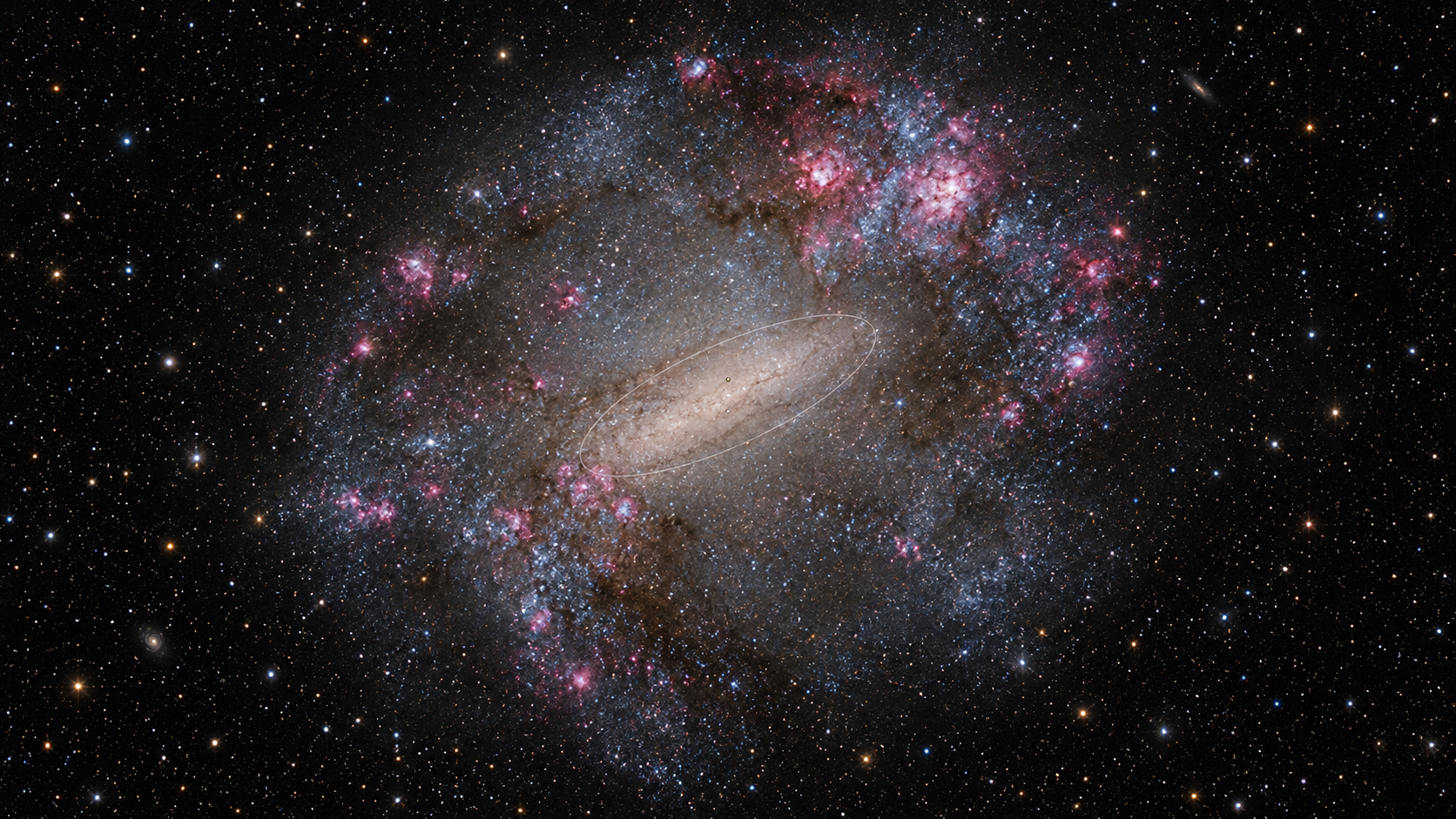
A galaxy located just fifty or so kiloparsecs from us could harbor a black hole of several hundred thousand solar masses without us yet knowing exactly where it resides.
That is the challenge tackled by Robin Chisholm, Elena D’Onghia, Niv Drory, Andrew Fox, and Noam Libeskind in a preprint posted on arXiv on September 14, 2026. Their paper, The Missing Black Hole in the Large Magellanic Cloud: A Dynamical Prediction for Its Present-Day Location, reports no detection of a black hole. It does something different: it calculates where such an object would most likely be located today if the clues accumulated in recent years pointing to its existence are correct. The manuscript has been submitted to The Astrophysical Journal and remains, at this stage, a preprint.
The distinction is essential. The authors obtain a probability distribution whose mean lies at equatorial coordinates (α, δ) = (80,23°, −69,55°), approximately 6 arcminutes north of the dynamical center they adopted. Yet the point of maximum probability the mode falls practically right on that center itself. Moreover, the uncertainty is vast compared to those six arcminutes: the 1σ ellipse has semi-axes of 1.34° and 0.56°.
In other words, no one has just dropped an X on a map saying “the black hole is right here.” Above all, the researchers have turned a poorly localized search into a quantifiable observational problem.
Why Suspect a Black Hole in the Large Magellanic Cloud?
The Large Magellanic Cloud LMC is an irregular satellite galaxy of the Milky Way. Its proximity makes it an exceptional laboratory for investigating a still poorly understood regime: that of massive black holes in galaxies far less imposing than our own.
The issue is that the LMC candidate, if it exists, appears remarkably inconspicuous. No blazing active galactic nucleus, no obvious accretion disk, and no direct stellar kinematic measurements have yet allowed it to be conclusively identified.
In 2017, a team mapped the velocity field of the LMC center using MUSE on the Very Large Telescope. They detected no black hole, but placed an upper limit of approximately 10^7.1 solar masses at 3σ, and roughly 10^6.4 solar masses 2.5 million solar masses at 2σ. Noticeably less massive objects therefore remained fully compatible with the data.
Evidence of an entirely different nature subsequently emerged from hypervelocity stars.
In 2018, an analysis of HVS3, a star moving at extreme velocity, showed that its trajectory traced back with high probability almost to the center of the Large Magellanic Cloud. Its relative velocity upon ejection was estimated at approximately 870 km/s. The authors concluded that a Hills mechanism the disruption of a binary system by a massive black hole offered the natural explanation for such an acceleration.
Then, in 2025, the matter became much more serious.
Jiwon Jesse Han and colleagues revisited the 21 gravitationally unbound B-type stars from the Hypervelocity Star Survey, combining their proper motions measured by Gaia DR3 with improved models of the LMC orbit. Roughly half of these stars traced back not toward the center of the Milky Way, but toward the Large Magellanic Cloud. Their model also reproduced their curious clustering on the sky toward the constellation Leo.
The proposed mechanism is elegant. When a binary star pair passes too close to a massive black hole, one star can be captured while the other is ejected at hundreds or thousands of kilometers per second. In the LMC, the galaxy’s own orbital motion adds roughly 300 km/s to certain ejections, generating a distinctive directional signature. From the number and velocities of these stars, Han and colleagues estimated the mass of the responsible black hole at around 6 × 10^5 solar masses, with substantial uncertainty.
It is a powerful clue. It is still neither a photograph nor a direct dynamical detection of the black hole.
The Unexpected Problem: Where Is the “Center” of the LMC?
In a regular and relatively undisturbed galaxy, one might begin by targeting its exact center and looking for a black hole there.
The Large Magellanic Cloud is a notoriously poor candidate for that approach.
Its center depends on what one measures: stellar distribution, stellar rotation, H I gas, the central bar, and stellar populations of varying ages. Different methods do not all yield the same coordinates. A Gaia DR3 analysis published in 2025, for example, places the dynamical center determined from red clump stars at (80,27°, −69,65°), but finds offsets of several tenths of a degree relative to other historical definitions of the center. The bar itself is offset by about 0.76 kpc from the center of the outer disk isophotes.
This messiness is not merely a measurement issue.
The LMC is a perturbed galaxy. It interacts with the Small Magellanic Cloud while evolving within the gravitational potential of the Milky Way. Gaia measurements and simulations suggest that a very close encounter between the two Clouds likely took place some 140 to 160 million years ago, with a passage at only a few kiloparsecs. Current observations of the disk demonstrate, furthermore, that it is not in dynamical equilibrium.
A central black hole is therefore not required to coincide today with the point where the galaxy appears brightest, nor even with a kinematic center derived from a specific stellar population.
It can “oscillate” around the minimum of the gravitational potential, while the disk and the bar themselves shift and deform.
Simulating 100,000 Virtual Black Holes
The new study tackles precisely this problem.
The researchers represent the LMC through three primary gravitational components: a spherical dark matter halo, a stellar disk, and a rotating central bar. The disk is not locked immovably to the center of the halo: it undergoes a time-dependent oscillation designed to mimic the large-scale asymmetry caused by the recent interaction with the Small Magellanic Cloud. In their model, this oscillation can reach amplitudes on the order of a kiloparsec.
To this internal potential are added those of the Small Magellanic Cloud and the Milky Way.
The hypothetical black hole is not launched from a single arbitrary starting point. The authors generate 100,000 orbits, sampling an initial position and velocity distribution plausible for a massive black hole evolving within a perturbed dwarf galaxy. In particular, the initial radius follows a distribution centered around 0.5 kpc, the vertical dispersion is 100 pc, and the adopted central velocity dispersion is about 35 km/s. Chandrasekhar dynamical friction is also included.
Each realization then evolves in the joint LMC–SMC–Milky Way potential up to the present day. Uncertainty regarding the timing of the last close encounter between the two Clouds is itself propagated: the evolution time is sampled around 156 ± 15 million years.
The outcome is therefore not “the orbit of the black hole.”
It is the final distribution of tens of thousands of trajectories compatible with the starting assumptions.
The Small Cloud Shook the LMC, but the Milky Way Sets a Direction
An intriguing physical distinction emerges from the model.
Internal disk asymmetry is primarily responsible for offsets within the plane of the LMC. Simulations routinely produce displacements on the order of 100 parsecs.
The external tidal field plays a different role. Despite the dramatic recent encounter between the two Clouds, the authors’ analytical calculations indicate that at the present day, the tidal pull of the Milky Way on the LMC center is roughly 10 to 50 times stronger than that of the Small Magellanic Cloud. It therefore imposes a preferred direction on the modest displacements perpendicular to the disk. The full model thus produces an average vertical offset of roughly 30 pc.
This does not mean the Milky Way is stripping the black hole away from the LMC. The authors estimate the galaxy’s Jacobi radius at roughly 20 kpc, far beyond the sub-kiloparsec scales examined here. The Galactic field is sufficient to gently perturb the central orbit, not to eject the object.
Six Arcminutes North, but Above All a Large Ellipse
Once the orbits are projected onto the sky, the mean of the final distribution settles at:
α = 80,23°
δ = −69,55°
That is approximately 6 arcminutes north of the bar center adopted by the team as the dynamical center.
At the distance of 49.9 kpc adopted in the model, six arcminutes correspond to roughly 87 projected parsecs. This number sounds impressive until compared with the uncertainty.
The 1σ ellipse has a semi-major axis of 1.34° and a semi-minor axis of 0.56°, oriented at roughly 93.5° east of north. At the distance of the LMC, this corresponds roughly to 1.2 kpc × 0.5 kpc in semi-axes. Its angular area is roughly 2.4 square degrees nearly twelve times the apparent area of the full Moon’s disk.
And there is another statistical nuance. For this two-dimensional distribution, the contour labeled “1σ” encloses approximately 38% of the probability, not the 68% one typically envisions with a one-dimensional Gaussian variable. The 2σ contour encloses roughly 86%. The authors explicitly note this in their figure.
The genuine takeaway is therefore less dramatic than “we know where the black hole is,” but scientifically more robust: we now know which regions to prioritize and with what uncertainty.
The Mean Is Offset. The Most Probable Point Is Not.
This is likely the most crucial nuance in the entire study.
The mean of the distribution falls six arcminutes north of the dynamical center. Yet when the authors locate the maximum probability density the mode of the distribution it coincides essentially with the adopted dynamical center.
There is no contradiction here.
An asymmetrical or skewed distribution can have its highest-density point in one location while its mean is shifted slightly by an extended tail in one direction. Here, disk perturbations and tidal forces produce precisely that type of non-symmetric geometry.
The authors go further still: their model provides no statistically significant evidence that the black hole is currently off-center. The various LMC centers proposed in the literature also remain well within the 2σ boundary.
Boiling the result down to “the black hole is located six arcminutes north of the center” would therefore misrepresent the paper.
The accurate statement is: the mean of the predicted distribution is located six arcminutes north, but its maximum remains at the center and the uncertainty encompasses a far broader area.
Hypervelocity Stars Tell the Past; This Model Seeks the Present
Another recent result explains why the current position could not simply be read off from hypervelocity stars.
In 2025, Scott Lucchini and Jiwon Jesse Han treated several of these stars as fossil trajectories: if they were ejected by the LMC black hole, their orbits must intersect the position that the black hole occupied at the moment of ejection. That work placed constraints on the past orbit of the LMC and located the reconstructed ejection site roughly 1.9° north of conventional centers in the framework compared by Chisholm and colleagues.
The new study finds a far smaller average displacement today.
This is not necessarily in tension. A star ejected several hundred million years ago records the location of the black hole at the time of its ejection. Since then, the LMC has continued its orbital motion, its disk has oscillated, the Small Magellanic Cloud has perturbed it, and the Milky Way’s gravitational field has continued to act.
The two methods therefore interrogate two distinct epochs of the very same system.
How Can the Prediction Actually Be Tested?
The first obvious candidate is already mapping the southern sky: the Local Volume Mapper of SDSS-V.
LVM performs integral field spectroscopy across the Large and Small Magellanic Clouds, with a physical resolution of approximately 10 pc in the Clouds, spectral coverage from 3600 to 9800 Å, and a spectral resolution of roughly R ≈ 4000. Ultimately, the instrument is slated to produce tens of millions of spectra across the Milky Way and its neighborhood.
Chisholm and colleagues highlight in particular the prospect of searching for coronal lines such as [Fe X] at 6375 Å. Such emission could betray gas ionized by an accreting black hole, even one accreting at a relatively low rate. The predicted region also overlaps several star clusters considered intriguing candidates for a nuclear component, including NGC 1916, which lies within 1σ on their map.
Yet LVM is no magical device for photographing the black hole.
This can be understood quantitatively. For a hypothetical mass of 600,000 solar masses and a stellar velocity dispersion of about 35 km/s, an elementary estimate of the gravitational radius of influence,
r ≈ GM / σ²,
yields only about 2 parsecs, or roughly 9 arcseconds at the distance of the LMC.
That is noticeably smaller than the physical scale of roughly 10 pc resolved by LVM. The survey is therefore especially valuable for catching a spectral accretion or ionization signature, but a clean dynamical measurement of the black hole mass would likely require targeted stellar observations at higher angular resolution.
This is where instruments like MUSE regain their utility. The 2017 experiment already demonstrated that central velocity-field spectroscopy of the LMC could set constraints on a black hole mass. A more refined probability map now allows costly observing time to be focused on better-motivated regions rather than treating the entire galactic center indiscriminately.
The upcoming 1001MC survey on 4MOST will supply another stream of information. It is designed to acquire spectra for roughly half a million stars across approximately 1,000 square degrees of the Magellanic Clouds to measure their kinematics and abundances. While not in itself a direct detection of the black hole, this massive sample should refine our understanding of the system’s potential and dynamics exactly the ingredients upon which the precision of this prediction hinges.
What If Astronomers Find Nothing?
An absence of signal within the favored region would not instantly rule out the black hole.
A quiescent object might produce virtually no identifiable electromagnetic emission. Its sphere of influence is small. The field is extraordinarily crowded with stars. And the calculated distribution remains broad.
On the other hand, each new constraint can systematically chip away at a different facet of the hypothesis: the lack of an accretion signature, the absence of kinematic disturbances around candidate clusters, upper mass limits imposed by stellar dynamics, a tighter determination of the center, and fresh hypervelocity star trajectories.
The model itself also has limitations that the authors acknowledge. It is not a full hydrodynamical simulation of the LMC. Disk oscillation is prescribed semi-analytically, and the initial conditions for the black hole are necessarily assumed. Furthermore, black holes in dwarf galaxies can remain wandering over distances of up to a kiloparsec in certain simulations; a broader initial distribution would widen the final map even further.
The researchers did, however, test one crucial parameter: the assumed mass. Rerunning the integrations with black holes of 6 × 10^4, 6 × 10^5, and 6 × 10^6 solar masses shifted the mean final position by only about one arcminute. The size of the ellipse varies more noticeably more massive objects experience greater dynamical friction but the mean location remains remarkably steady within this modeling framework.
The Real Advance Is Not Having “Found” the Black Hole
The Large Magellanic Cloud thus remains a galaxy with an intriguing conundrum at its center: several ultra-fast stars appear to have been flung outward by a compact object on the order of 600,000 solar masses, a mass fully consistent with earlier dynamical limits, yet that object has never been directly observed.
The new study does not resolve that paradox.
It makes it testable.
Rather than arbitrarily assuming that the black hole must sit at the photometric center, the gas center, or the midpoint of the bar, the authors statistically evolve the object within a galaxy that was genuinely shaken by its galactic environment. What they deliver is not a magical set of coordinates, but a map: a prioritized region, an orientation, uncertainty boundaries, and concrete observational targets.
It is less headline-grabbing than a discovery.
It is also exactly the kind of prediction that, with new observations, can ultimately produce one.