Saturn Has Just Fabricated a Decagon and No One Yet Knows Why
We knew about the immense hexagon at Saturn's north pole. Its south pole has now revealed a ten-sided structure that appears to have emerged before our eyes. This is not a geometric curiosity: it is a rare natural experiment in how a chaotic atmosphere can spontaneously organize itself.
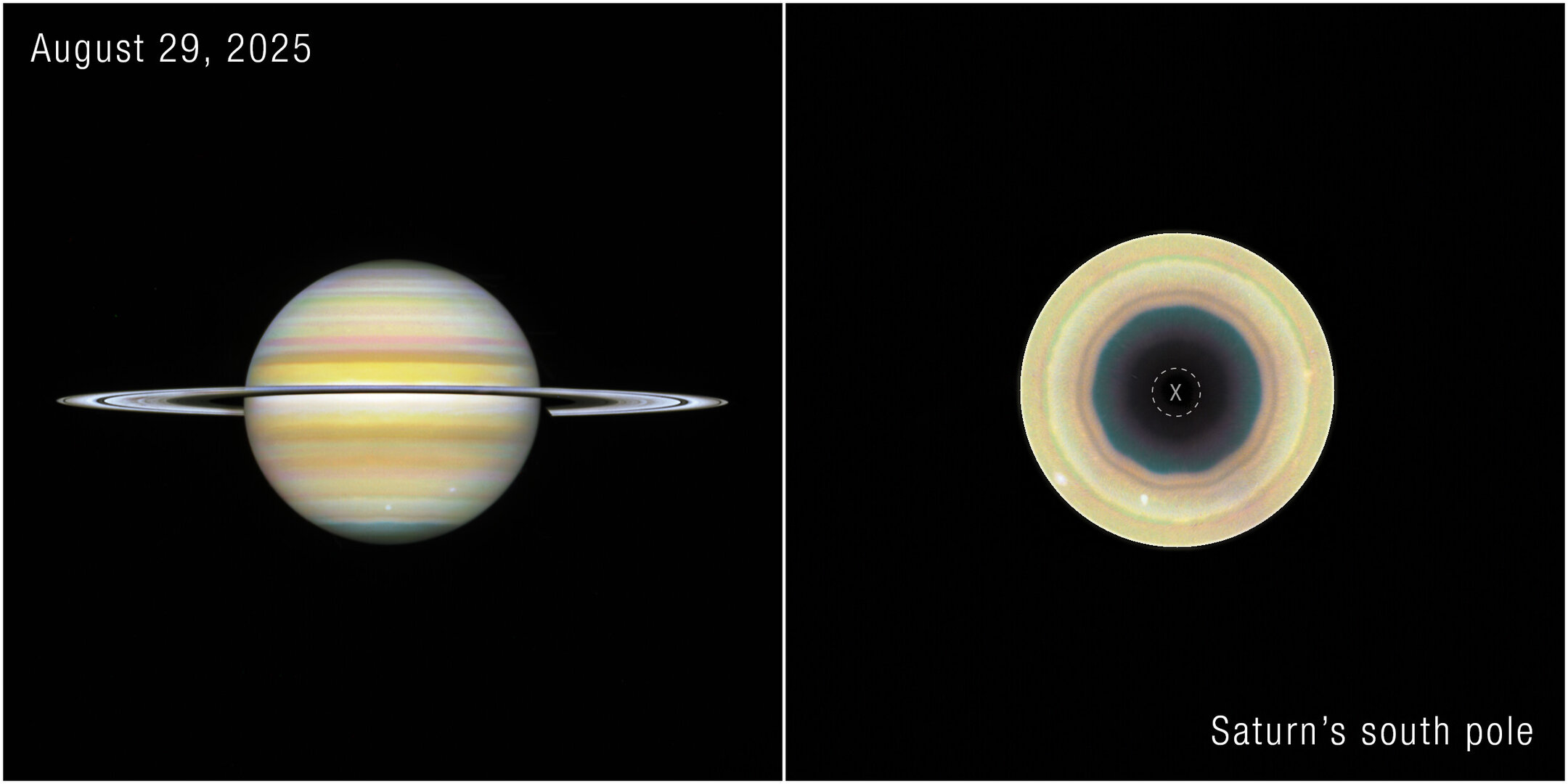
There are now two enormous polygons in Saturn’s atmosphere.
Not drawn on its surface. Not created by any topography. Saturn does not even have a true solid surface on which to place them.
It is the winds themselves that take on a geometric shape.
To the north, we already knew one of the strangest phenomena in the Solar System: a gigantic atmospheric current forming an almost regular hexagon around the pole. It is so large that several Earths could fit inside, and we know it has persisted for at least several decades.
To the south, by contrast, nothing comparable.
Then something appeared.
Analyzing several years of observations from the Hubble Space Telescope, a team led by Agustín Sánchez-Lavega identified around Saturn’s south pole a gigantic atmospheric wave possessing not six…
but ten sides.
A decagon.
And the most interesting detail is not even its shape.
It is that it was apparently not there before.
We May Be Watching a Planetary Structure Be Born
This is what turns this discovery into something far more interesting than just another pretty photograph of Saturn.
Researchers have long sought a southern counterpart to the famous hexagon.
They had good reasons.
Saturn’s atmospheric current systems exhibit a certain symmetry between the two hemispheres. As early as the 1990s, astronomers therefore scoured available observations for a comparable structure in the south.
Nothing.
The Cassini probe then spent thirteen years around Saturn, from 2004 to 2017.
Still no sign of a durable southern polygonal structure.
Then the south pole, long difficult to observe from Earth because of Saturn’s tilt and seasons, gradually returned to better viewing conditions.
Hubble data now allow traces of the structure to be found as early as 2023. Professional and amateur astronomers noticed a wavy band in 2024 observations. It becomes more convincing in ground-based images taken in 2025, then Hubble finally makes it possible to clearly distinguish the geometry.
In other words, we may not have simply discovered something that was hidden.
We may have caught the formation of a planetary-scale atmospheric phenomenon over several years.
And that completely changes the scientific question.
It is no longer just a matter of asking:
“Why does Saturn have polygons?”
We can now ask:
“What makes an atmosphere suddenly decide to fabricate one?”
How Can Wind Have Sides?
This is probably the most counter-intuitive part of the whole story.
A hexagon or a decagon immediately evokes something solid: crystal, molecular structure, architecture.
Yet here, there is no wall.
The decagon is a wave in a jet stream.
Imagine an immense atmospheric river circling the pole.
If its flow were perfectly uniform, its trajectory would remain approximately circular. But fast fluids are rarely that well-behaved. Certain perturbations can grow, interact with the current, and produce a stable wave.
The circle then begins to undulate.
If this wave has a particular wavelength, several maxima and minima distribute themselves around the pole.
Viewed from above, the current’s boundary no longer resembles a circle.
It begins to form sides.
This is an important idea: the geometry is not imposed on the atmosphere. It emerges from its dynamics.
The same general principle appears in many physical systems. A set governed by relatively simple rules can spontaneously develop an organized structure without an outside architect.
In Saturn’s case, the result is simply spectacular because the experiment takes place at the scale of a planet.
Ten Sides in the South, Six in the North
This is where the new decagon becomes even more valuable.
If Saturn possessed only its northern hexagon, we might still suspect that an extremely particular combination of local conditions was necessary for its existence.
But now, the planet seems to demonstrate that it can produce several different polygonal states.
The north selects six sides.
The south selects ten.
This suggests that the number of sides is probably not a fundamental property of Saturn itself, but the result of the jet’s local conditions: wind speed, jet width, velocity gradients, vertical atmospheric structure, latitude, and interactions between different layers can all contribute to selecting the wave mode that survives.
It is a bit like a string that can vibrate in several modes.
The string remains the same.
It is the physical conditions that determine which vibration shape dominates.
This comparison has its limits—Saturn’s atmosphere is infinitely more complex than a string—but it helps explain why “six versus ten” is scientifically more interesting than the existence of a second identical polygon.
Saturn may have just given us two different solutions to the same physical problem.
And This Is Probably Not Just a Drawing in the Clouds
Hubble does not observe Saturn in a single color.
Its instruments use different filters, therefore different wavelengths. And these do not reveal exactly the same atmospheric depths.
This is where a particularly important clue appears.
The decagon remains detectable across several atmospheric levels, even if its apparent position varies slightly depending on the wavelength observed.
This indicates that it is probably not a thin cloud decoration floating at a precise altitude.
The structure possesses a vertical extent.
The phenomenon therefore genuinely concerns atmospheric dynamics.
And this provides researchers with an additional constraint: any model capable of explaining the decagon will have to reproduce not only its horizontal geometry, but also its behavior at different altitudes.
The Trap Would Be to Declare That Saturn Now Has Two Permanent Polygons
We do not know that.
That is precisely what makes the southern case exciting.
The northern hexagon is remarkably durable. It was already observable in Voyager data in the early 1980s and continued to be tracked decades later.
The decagon, by contrast, seems to be evolving.
Observations suggest it has strengthened since 2023.
It could therefore end up becoming a durable structure comparable to the northern one.
But it could also deform, change mode, or disappear.
Researchers do not yet know what triggered it, how long it will survive, or why it appeared now. Future Hubble observations, James Webb Space Telescope observations, and numerical simulations should allow different explanations to be tested.
And paradoxically, its disappearance could be almost as interesting as its survival.
Because a hexagon observed for forty years shows us a stable state.
A decagon that we see appear, evolve, and possibly die could show us the mechanism for reaching or leaving that state.
Saturn Has Become an Experiment We Could Never Have Built
There is something elegant about this discovery.
On Earth, we can study fluid dynamics in tanks, wind tunnels, and numerical simulations. We can modify speed, rotation, or gradients and watch the structures that appear.
But no one can experimentally build a planet-sized hydrogen atmosphere, spin it for decades, and wait for a jet stream to decide to become polygonal.
Saturn does this experiment all by itself.
And we may have just obtained something particularly rare in planetary science: not a photograph of a phenomenon already installed for centuries, but a time series of its birth.
This is also why repeated Hubble observations matter so much. The OPAL program has been regularly photographing the giant planets for more than a decade. An isolated observation of Saturn in 2025 would have shown a decagon.
It would not have shown its history.
It is the apparently repetitive years of data that now allow us to look back and see that something was in the process of changing.
The discovery therefore tells two stories at once.
The first concerns Saturn: a planet whose atmosphere is capable of transforming a turbulent current into a gigantic geometric structure, then perhaps of changing its shape over the seasons.
The second concerns our way of doing science: some discoveries do not necessarily require a more powerful telescope.
They simply require looking at the same world long enough to catch it in the act of changing.