The sky we see no longer exists.
Looking at the sky is like receiving images from the past, delayed by time. Eight minutes for the Sun, 2.5 million years for Andromeda, and almost the entire history of the universe for the cosmic background: how far back can we actually see?
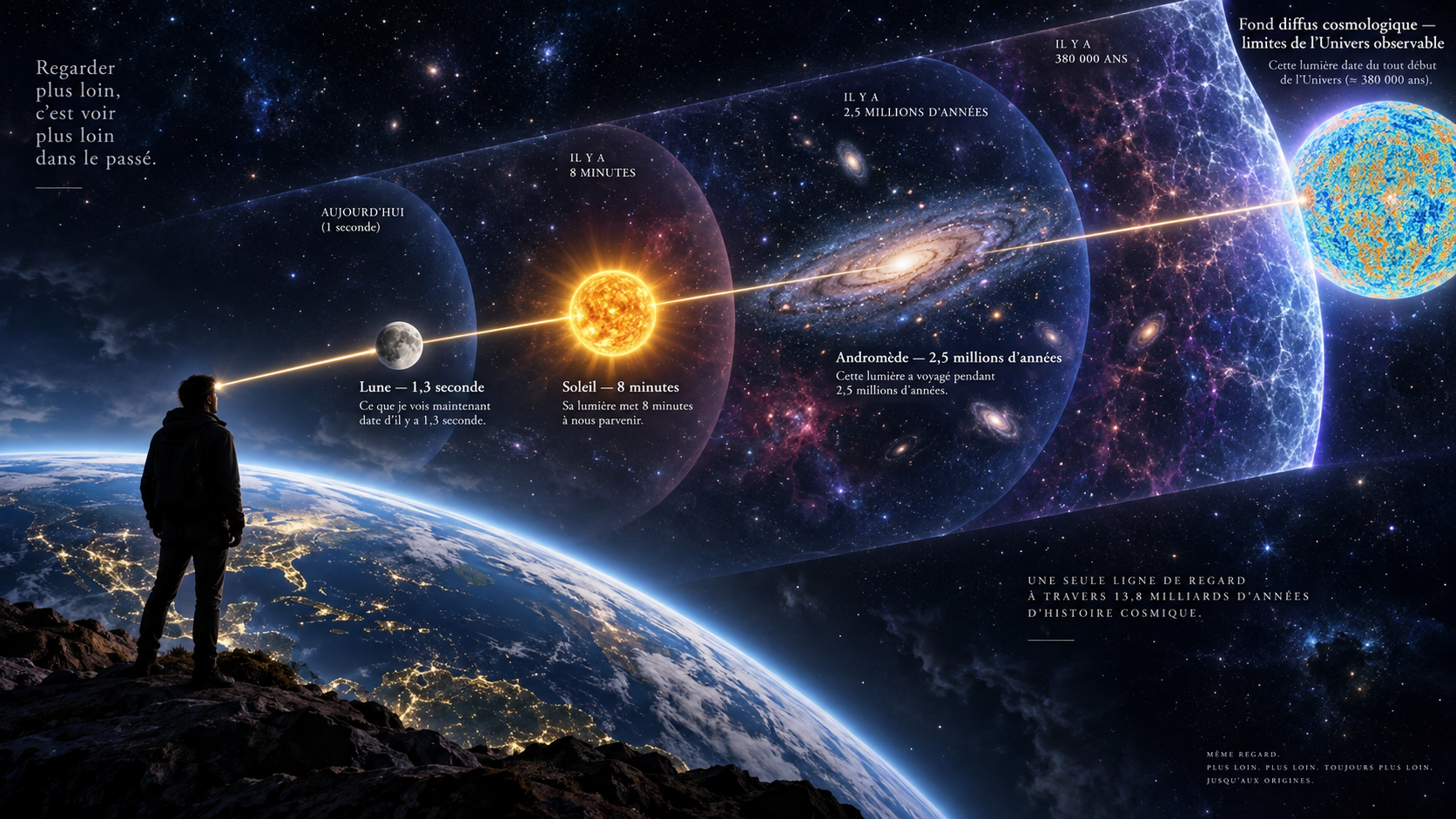
There’s something profoundly unsettling about the sky.
When I look at someone a few meters away, my brain can reasonably perceive them as if I am seeing them “now.” The light takes so little time to travel that distance that the delay is imperceptible. However, this perception breaks down when the distances become astronomical.
The sky is not a real-time image of the universe. It is a collection of images from the past.
The further back in time we look, the more distant and ancient that past becomes.
Seeing is always looking back.
Light travels through a vacuum at approximately 300,000 kilometers per second. This is incredibly fast, but it is not instantaneous. On the scale of the universe, even this speed becomes incredibly slow.
The light from the Moon takes approximately 1.3 seconds to reach us. The light from the Sun takes approximately 8 minutes and 20 seconds to travel the roughly 150 million kilometers that separate us. When we look at the Sun, of course, we never see it directly without appropriate protection, so we are not seeing the Sun as it is at that precise moment; we are seeing the photons it emitted about eight minutes earlier.
This rule applies not only to visible light. Radio waves, infrared, ultraviolet, X-rays, or gamma rays are also forms of electromagnetic radiation and travel at the same speed in a vacuum. Therefore, a telescope never truly “sees” a distant object in real-time.
This difference can be summarized with a few examples:
| What we observe | What we approximately see |
| The Moon | 1.3 seconds ago |
| The Sun | 8 minutes 20 seconds ago |
| Proxima Centauri | approximately 4.2 years ago |
| Milky Way center | approximately 26,000 years ago |
| Andromeda Galaxy | Approximately 2.5 million years ago |
| Cosmic Microwave Background | Universe approximately 380,000 years old |
In other words, distance is also a time-traveling device.
If the Sun were to disappear, we wouldn’t immediately realize it.
Let’s consider a hypothetical scenario: imagine that the Sun suddenly disappears.
For approximately eight minutes, nothing would seem to have changed on Earth. The last photons already in transit would continue to reach us. Even stranger, according to the theory of general relativity, the change in the Sun’s gravitational influence would not reach us instantaneously either: gravitational disturbances propagate at the speed of light. During this period, the Earth would continue to move as if the Sun were still there.
Then, the information would eventually reach us.
The darkness and gravitational changes would not be “delayed” due to a faulty machine. This delay is an inherent part of the very structure of the Universe: no physical information can simply appear everywhere instantaneously.
However, be mindful of the example of a solar eclipse.
There’s a rather subtle trap here. One might be tempted to say: “Since I see the Sun with an eight-minute delay, when a solar eclipse appears in my sky, it must have already been over eight minutes earlier.”
That’s not quite right.
A solar eclipse is not an event that occurs on the Sun. It results from the Moon positioning itself between us and the solar photons, and blocking them near the Earth. The photons in question had indeed left the Sun about eight minutes earlier, but the eclipse itself depends on the Moon’s position along their path. Therefore, it is important to distinguish the age of the solar light we receive from the geometric event known as a solar eclipse.
The initial intuition remains valid: the Sun we see is a relic of the past. However, the sky becomes much more interesting once we stop treating “eight minutes late” as an overly simplistic rule.
Andromeda: A photograph from 2.5 million years ago
Then there’s Andromeda.
The Andromeda Galaxy is located approximately 2.5 million light-years away from us. A light-year is not a duration; it is the distance light travels in one year. This means that the photons from Andromeda that arrive on Earth today left there about 2.5 million years ago.
When we observe Andromeda tonight, we are seeing it as it was at a time when the first representatives of the Homo genus already existed on Earth, but when our own species was still very far from appearing.
And that’s the dizzying part: we don’t know what Andromeda looks like “now” when we observe it from Earth. Events are likely happening there at this very moment, according to our usual understanding, but their light will still take millions of years to reach us.
If the Andromeda galaxy’s star exploded today, no living human on Earth would be able to see the explosion. Nor would our children, or their descendants for a period of time that is difficult to imagine.
The information might already be available there. However, it simply doesn’t exist for us yet.
Telescopes are, in a sense, machines that allow us to look back in time.
This is what makes telescopes like the Hubble and James Webb telescopes so much more interesting than a simple “giant zoom lens.”
Their goal is not simply to observe extremely distant objects. By capturing light that was emitted billions of years ago, they allow us to study different periods in the history of the universe.
NASA describes the Hubble telescope as a kind of time-traveling machine: the further away an object is, the older its image appears to be.
James Webb is taking this principle to an extremely advanced level today. Observations confirmed by Webb, for example, show the MoM-z14 galaxy as it existed approximately 280 million years after the Big Bang. Its light traveled for about 13.5 billion years before reaching us.
Therefore, we are not simply reconstructing the history of the Universe based on fossils or simulations. A part of this history actually reaches us directly, in the form of photons.
The sky is a record.
So, can we look far enough to see the Big Bang?
That’s where the idea becomes even more intriguing.
Intuitively, one might think that all it would take is to create an infinitely powerful telescope. “Further” means “older,” so it would simply be a matter of continuing until we reach the zero point.
But no.
We cannot directly observe the Big Bang with light.
The problem isn’t the power of our telescopes. It’s the primordial universe itself.
During its first hundreds of thousands of years, the Universe was extremely hot and filled with a dense plasma of electrons and atomic nuclei. Photons were constantly scattered by the charged particles. For light, the Universe resembled a gigantic, opaque fog.
Subsequently, approximately 380,000 years after the Big Bang, the Universe had cooled sufficiently for electrons to combine with nuclei and form neutral atoms. This allowed light to finally travel freely over long distances.
These photons are always in motion.
We detect them today in the form of the cosmic microwave background (CMB).
This is the earliest light we can observe. It represents a true “snapshot” of the Universe when it was only about 380,000 years old. Missions such as COBE, WMAP, and Planck have mapped this radiation with extraordinary precision.
Therefore, it’s not quite:
“We can see the Big Bang.”
This is something more specific, and, in my opinion, even more impressive:
We can actually receive light that was released when the universe was only about 0.003% of its current age.
Before this, the universe was essentially opaque to the photons that we use to observe the cosmos.
And the Big Bang wasn’t located somewhere deep in the sky.
We need to get rid of another misleading mental image.
The Big Bang was not an explosion that occurred in a specific location within an immense, empty space. There is no particular direction in the sky to which a telescope should be pointed to observe “the place where everything began.”
According to modern cosmology, the expansion has occurred everywhere. There is no central point in space from which the Big Bang originated, which we could locate. John Mather, Nobel laureate and scientist from the James Webb telescope, rightly points out the misleading nature of the term “Big Bang” when it evokes an image of an explosion with a central point.
This is also why the cosmic microwave background radiation surrounds us in all directions.
Look very far to the left: Young Universe.
Far to the right: Young people.
Above: Young universe.
If the Earth weren’t in the way, we could see it: the young universe, still expanding.
We are at the center of our observable universe, but this does not mean that we are at the center of the universe.
How can the observable universe measure 92 billion light-years?
Here is another peculiarity that initially seems impossible.
The universe is approximately 13.8 billion years old. Therefore, one might assume that we can only observe anything up to about 13.8 billion light-years away, and that the observable universe should have a maximum diameter of 27.6 billion light-years.
However, its current diameter is estimated to be approximately 92 billion light-years.
There is no contradiction.
While the photons were traveling towards us over billions of years, the space itself continued to expand. As a result, the region from which some of these photons originated is now much further away from us than it was at the time they were emitted.
This is a fundamental distinction between two questions that appear to be the same, but are not:
“How long has this light been traveling?”
and
“How far away is the region that issued it today?”
At cosmological distances, these two numbers can be vastly different.
Could someone have observed dinosaurs on Earth?
This idea leads to a wonderful thought experiment.
The light reflected by the Earth 66 million years ago is still somewhere in the universe, traveling outwards.
In theory, an observer located approximately 66 million light-years from Earth would today be receiving photons that originated here during the time of the extinction of the non-avian dinosaurs. With a hypothetical instrument capable of achieving a resolution far beyond the capabilities of our current technology, they would be observing a 66-million-year-old Earth.
However, this does not mean that we could build a spacecraft, travel that far, and point a telescope at Earth to observe our own past.
The photons have already left at the speed of light.
To catch up with them after their departure, we would need to surpass them. However, the theory of relativity prohibits any physical object from simply accelerating beyond the speed of light in a vacuum. Therefore, the magnificent archive of light from our past exists somewhere in space, but it is receding from us at a speed that we cannot exceed.
And what about the future?
This is where asymmetry becomes significant.
We can see the past because the signals from the past have had time to reach us. We cannot observe the future in the same way, because the photons carrying information about these events have not yet been emitted.
In relativity, this idea is formalized by what physicists call the light cone. Our past light cone contains the events that could have sent a signal to us. Our future light cone contains the events that the signals we send today could potentially influence.
Even our intuition of “being everywhere in the Universe at once” must be approached with caution. The theory of special relativity demonstrates that the simultaneity of distant events depends on the observer’s frame of reference: two observers in relative motion may not agree on events that should be considered simultaneous.
Therefore, cosmic time is much less intuitive than our everyday perception of a vast, universal present that is advancing uniformly everywhere.
We never see a single universe.
When we look up, we feel as though we are gazing at a space filled with objects that all exist simultaneously.
This isn’t really what we’re seeing.
The Moon belongs to our past, just a few seconds ago. The Sun, to our past, just eight minutes ago. Some stars appear as they did before our great-grandparents were born. The center of our galaxy has been reaching us since a time before agriculture. Andromed is showing us a world that is 2.5 million years old. And behind the oldest galaxies, there is still this ancient light from a universe that is only 380,000 years old.
Therefore, a single night contains several billion years of history superimposed on the same sky.
We thought we were looking at the stars.
In reality, whenever we look far enough, we are also looking into the past.